South Korean soldiers participate in an anti-terrorism exercise, linked to the ongoing joint military drills known as Ulchi Freedom Shield (UFS), at Lotte Hotel World on Aug. 19, 2026 in Seoul, South Korea. (Chung Sung-jun/Getty Images)
(LONDON) — South Korea’s Joint Chiefs of Staff (JCS) confirmed that ongoing joint military drills with U.S. forces would end early, following President Donald Trump’s announcement Sunday that he had ordered the Pentagon to “substantially reduce” the exercises.
The annual U.S.-South Korea Ulchi Freedom Shield began Monday. On Wednesday, South Korea’s Joint Chiefs of Staff said in a statement that, in response to a U.S. proposal, “the allies agreed to adjust parts of the exercise, including its duration and scale.”
The drills will now end Aug. 21, six days earlier than originally planned. The two sides also agreed to scale back some combined field training exercises, the details of which are still under discussion, the JCS said.
“Going forward, South Korea and the United States will discuss and implement various measures to achieve the objectives of the UFS exercise and maintain a strong combined defense posture,” the statement added.
A Pentagon official told ABC News that the exercise had been “substantially reduced” on “direction from the president and secretary of war.”
“The exercise will conclude on Aug. 21, one week earlier than scheduled. Associated live-training events have been reduced, with certain events canceled or converted to simulations,” the official said. “These adjustments preserve essential readiness and training objectives. There will be no degradation to U.S. training objectives.”
Trump ordered the drills scaled back, citing his “very good” relationship with North Korea’s Supreme Leader Kim Jong Un. Pyongyang routinely protests joint U.S.-South Korean exercises, framing their military cooperation as undermining stability on the Korean Peninsula.
This week, Pyongyang described Ulchi Freedom Shield as an “open threat” to North Korea.
On Sunday, Trump criticized the annual military exercise as “inappropriate and hostile” toward North Korea, a country he said has been “unthreatening and respectful” toward the United States during his presidency.
“Based on my very good relationship with Kim Jong Un, of North Korea, I am not happy with the fact that the United States has, long ago, agreed to participate in Joint Military Exercises with South Korea,” Trump wrote on his social media platform.
“Therefore, and based on the fact that it is too late to cancel, I have instructed Secretary of War, Pete Hegseth, to substantially reduce the Joint Military Exercises!” he said.
South Korea is a longtime U.S. ally and hosts roughly 28,500 U.S. troops. The U.S. presence on the peninsula has traditionally been intended to prevent a resumption of cross-border hostilities, with the Korean War of 1950-53 having never officially ended.
In 2006, North Korea tested its first nuclear weapon and has since been expanding its atomic weapons stockpile — despite international condemnation and sanctions led by successive U.S. administrations — alongside a ballistic missile research program which has produced munitions capable of reaching the continental U.S.
In recent decades, the U.S. presence in South Korea has also become an important point of leverage in the strategic contest between Washington and Beijing, the latter having long served as Pyongyang’s prime patron.
ABC News’ Joohee Cho, Desiree Adib, Will Gretsky and Steve Beynon contributed to this report.
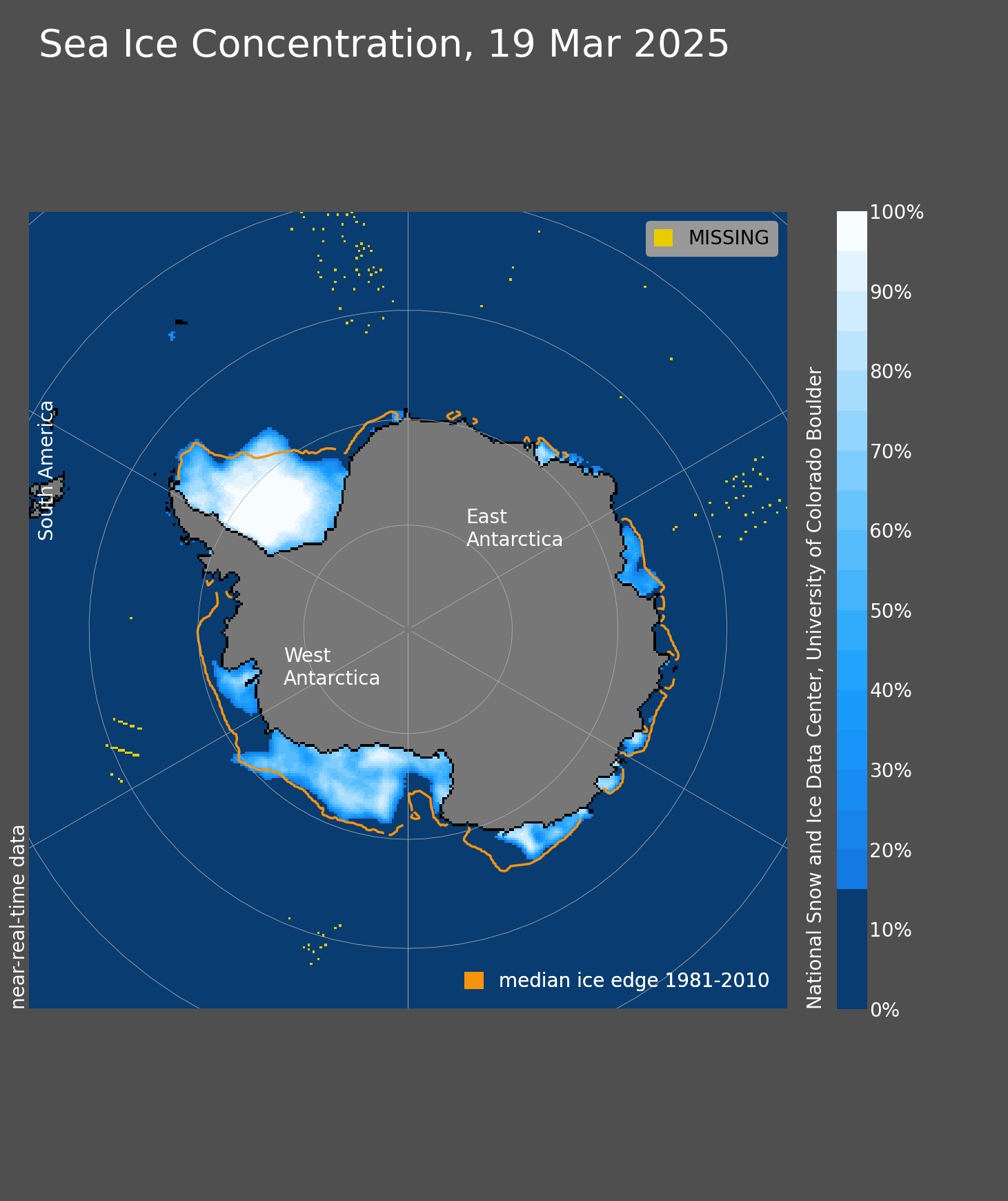
Sea ice concentration, June 14, 2026. (National Snow and Ice Data Center)
(ANTARCTICA) — A massive chunk of sea ice in West Antarctica has not refrozen following a winter heatwave in the region – a dramatic change that could further contribute to global sea level rise, experts told ABC News.
Graphics based on satellite imagery from the University of Colorado Boulder’s National Snow and Ice Data Center taken on Sunday show a large portion of sea ice measuring approximately 150,000 square miles – roughly the size of Montana – is not included in what is typically already frozen at this time of year, which is mid-winter in the Southern Hemisphere, experts told ABC News.
Every winter, Antarctic sea ice grows and decays, Peter Neff, a glaciologist at the University of Minnesota who specializes in ice core records, told ABC News. But since 2015, Antarctic sea ice has entered a “new, much reduced state,” in which less and less is re-freezing due to rising air and sea temperatures, Neff said.
This year, the level of sea ice in West Antarctica is about 50% lower than average, Neff estimated.
“This is a dramatic but not surprising observation in the context of the huge changes that have been occurring in Antarctica, particularly in this region of Antarctica, over the past decade,” Chuck Amsler, a professor of biology at the University of Alabama at Birmingham, told ABC News.
If the West Antarctica Ice Sheet were to collapse in its entirety, it has the potential to contribute more than 10 feet in sea level rise, according to a 2025 study by the International Thwaites Glacier Collaboration, a partnership between U.S. and U.K. agencies.
It is possible that this year’s June sea ice level in the area may surpass last year’s record low, Rose Malanga, a Ph.D. student at the University of Illinois Urbana-Champaign who conducted field research in Antarctica earlier this year, told ABC News. In June of both this year and 2025, the region had some of the lowest sea ice levels on record, Ellen Buckley, an assistant professor at the University of Illinois Urbana-Champaign’s Department of Earth Science and Environmental Change, told ABC News.
Data gathered by the Copernicus Earth observation program in June 2025 showed there was 12.6 million square kilometers of Antarctic sea ice, which is about 1.3 million square kilometers less than the 1991-2020 average.
Contributing factors likely include strengthening westerly winds, a phenomenon that’s connected to global warming due to climate change, as well as how the ocean is responding to those surface winds, Neff added.
A low-pressure anomaly north of the Bellingshausen Sea, which is adjacent to West Antarctica’s Antarctic Peninsula, is likely causing warm air from higher latitudes to warm the region and prevent sea ice formation, Buckley said.
“Winds drive how the ocean moves, but satellites can’t see into the ocean, so without being able to get down there, especially during the wintertime, we have very limited ability to do research,” he said.
The news of the lack of sea ice comes on the heels of above-average temperatures in the region, records show.
From January through April, the Bellingshausen Sea, where the ice would typically form, has seensea surface temperatures anywhere from 1.8 to 5.4 degrees Fahrenheit above average, according to National Oceanic and Atmospheric Administration data. Throughout May, the sea surface conditions cooled slightly but remained about 1.8 to 3.6 degrees Fahrenheit above average temperatures.
In June, the Bellingshausen Sea surface temperature varied by as much as 1.8 degrees Fahrenheit above normal. Air temperatures over the Bellingshausen Sea are forecast to be up to 18 degrees Fahrenheit above average from Tuesday through the weekend.
The area that has not yet refrozen is located upwind of the regions on the Antarctic Peninsula that just experienced this warming. The heat wave can contribute to the lack of sea ice extent because there is not reflective white ice surface to keep it cold, Neff said.
“With this kind of situation where there isn’t sea ice forming in the winter, that means in the spring there will be less sea ice to melt,” according to Buckley.
The question of why the Antarctic sea ice freeze and thaw cycle has been behaving differently in the last 10 years, compared to the previous 30 years, is a “huge area of research” right now, Neff said, especially in the western region of the continent, which is being monitored closely by scientists.
Glaciologists have taken a particular interest in Antarctica’s western shelf due to its potential to cause a severe rise in sea levels. Thwaites Glacier, also known as the “Doomsday Glacier,” already contributes to 4% of overall sea level rise, while Pine Island Glacier is one of Antarctica’s fastest-melting glaciers.
Deterioration of the remaining portion of the Thwaites Glacier’s floating ice shelf has been accelerating in recent months and is likely to break off in the coming weeks or months, Neff said, adding that while it won’t completely destabilize the glacier it will contribute significantly to global sea level rise.
The Antarctic Peninsula is warming about five times faster than the global average. The most severe heat event occurred in March 2022, when the continent recorded temperatures between 54 degrees and 72 degrees Fahrenheit above normal.
“The warm events are expected to be coming more frequently,” Neff said.
ABC News’ Kenton Gewecke and Sam Wnek contributed to this report.
South Korean President Lee Jae-myung takes an oath during his inauguration at the National Assembly on June 04, 2025 in Seoul, South Korea. (Photo by Anthony Wallace – Pool/Getty Images)
(SEOUL, South Korea) — South Korea’s ruling Democratic Party swept nationwide local elections Wednesday, tightening President Lee Jae Myung’s grip on power one year into his term, though the conservative opposition captured Seoul’s mayor’s office.
The vote drew 61% turnout, the highest for a local election in three decades.
Lee enters his second year Thursday with approval ratings around 60%, according to South Korea’s major pollsters. That is the second-highest at the one-year mark since 1987, behind only former President Moon Jae-in.
When South Koreans elected Lee a year ago, they did so in the wreckage of a constitutional crisis after then-President Yoon Suk Yeol declared martial law on Dec. 3, 2024, vowing to “eradicate the anti-state forces.”
He sent troops toward the National Assembly to stop lawmakers from voting it down. The attempt failed within hours, and Yoon was impeached and removed by the Constitutional Court four months later, triggering the snap election that made Lee president.
Governing out loud
Lee has made the presidency unusually public. He live-streams weekly cabinet meetings, a first in Korean history, and his office briefs on camera far more than its predecessor.
Lee also uses social media to announce policy, rebut coverage he disputes, take questions and air his opinions — often without the vetting a formal statement would get. Aides call it a deliberate effort to reach citizens directly rather than through the traditional layers of staff that usually filter a president.
“Unlike politicians before him, he’s citizen-friendly — clearly distinct,” said Park Myoung-ho, a political science professor at Dongguk University.
His style has drawn criticism, however. In May, Lee used social media to attack Starbucks Korea over a promotion that critics linked to a 1980 massacre of pro-democracy protesters, branding the company “low-grade profiteers” guilty of “gutter-level behavior.”
“Given how much power a president holds, it’s too direct and too unfiltered,” said Lee Hyun-woo, who teaches political process at Sogang University and warned that the president’s posts are often misread because Koreans are used to presidents speaking in measured, formal language.
A record-breaking market
The benchmark KOSPI, which bottomed out near 2,300 in April 2025 after President Donald Trump’s tariffs, has surged to a record high above 8,700, blowing past Lee’s campaign pledge to reach 5,000. The rally has been catalyzed by a global boom in semiconductors and AI infrastructure that has lifted companies like Samsung Electronics and SK Hynix.
But rising share prices have not reached many ordinary households across the country and home prices around Seoul are starting to climbing again and is testing one of Lee’s central promises.
Walking the line between Washington and Beijing
Lee’s central foreign-policy bet has been that South Korea no longer has to choose between its U.S. alliance and its largest trading partner, China — an approach his government calls “national-interest-centered pragmatism” — and within seven months of taking office, he had held summits with the leaders of the United States, China and Japan.
“On foreign policy, he’s done better than expected,” said Shin Yul, a political science and diplomacy professor at Myongji University.
But the results have been mixed. Lee repaired ties with Japan, but his January state visit to Beijing largely fell flat.
His pragmatism faced a major test in February when the war between Iran and a U.S.-Israeli coalition threatened the Strait of Hormuz, the route for much of South Korea’s oil imports.
Lee’s government leaned on national reserves, increased purchases of U.S. crude and secured replacement supplies from outside the region. A senior presidential official said the effort, together with the market’s resilience, helped keep Lee’s approval ratings steady through the spring.
Two presidents, two reckonings
In February, a Seoul court sentenced former President Yoon to life in prison for the martial-law attempt; his former defense minister got 30 years. To Lee’s supporters it was accountability for an assault on democracy. To Yoon’s base, it felt like political revenge.
But Lee carries his own legal shadow. He took office facing five criminal trials, including corruption, subornation of perjury and illegal fund transfers to North Korea, which were all frozen once he became president.
His Democratic Party then went further by pushing a special counsel that could cancel the charges against him outright — a move Lee declined to endorse or oppose publicly.
To Shin, the silence was strategic. Lee’s side, he said, “will try to get the charges dropped,” likely using the special counsel “to pursue cancellation of the cases against him.”
The push drew public backlash and many analysts read the local-election result as a warning from voters wary of a governing party clearing its own leader.
“This may be President Lee’s Achilles’ heel,” said Park. “I suspect he himself feels a real burden over it.”
For Lee Hyun-woo, the principle is simple: “Serving well and being remembered as a great president, and paying for crimes committed in the past, are entirely separate matters.”
ABC News’ Hakyung Kate Lee contributed to this report.