Hurricane Polo makes Baja landfall, headed for a 2nd in Mexico
Tracking Hurricane Polo. (ABC News)
(NEW YORK) — Hurricane Polo made landfall in Baja California overnight and is expected to make a second landfall on the mainland of Mexico on Tuesday.
Polo slammed the Baja California Peninsula near Las Barrancas as a Category 2 hurricane, packing dangerous winds of 96 to 110 mph.
After making landfall around 11 p.m. local time, Polo was downgraded to a Category 1 storm as it trekked across the Baja and took aim at the Sonora region of mainland Mexico.
There were no immediate reports of damage or injuries.
Polo formed into a Pacific hurricane on Sept. 20, one of three hurricanes to develop in the Pacific at the same time.
Near-record levels of moisture are coming in from the Pacific, aided by strong flow from Polo.
The hurricane’s remnants will eventually merge later Tuesday with an existing storm system and supercharge moisture across a large swath of the United States.
More than 30 million people on Tuesday across a dozen states from California and Texas to Iowa are under a flood watch.
Overnight, multiple flash flood warnings were in effect across Utah and Arizona.
Zion National Park saw near-record flooding along the Virgin River and Heaps Canyon as a flash flood wave moved through on Monday night.
Water rescues were made on Monday evening in Bullhead City, Arizona, after a vehicle got trapped in floodwaters.
(GERMANY) — The American doctor who contracted Ebola and was transferred to Germany is starting to feel better and is able to eat, according to his colleague.
Dr. Peter Stafford is currently hospitalized in Berlin’s Charite University Hospital after testing positive for the disease due to his work in the Democratic Republic of the Congo.
His colleague, Matt Allison — the executive director of Serge, the Christian missionary group Stafford works for — told ABC News that the doctor has been receiving monoclonal antibodies during his hospitalization.
Allison said it appears Stafford’s condition has improved since landing in Germany and that he has been able to text his colleagues.
“He needed assistance to walk. He was very weak. He was discouraged … he was talking about just being almost unable to think,” Allison said. “I mean [it] was the combination of the isolation, the uncertainty, feeling really sick. It was a lot to carry. And so I’m so glad that he’s responding quickly to us.”
Allison went on, “He feels good. He’s eating. You know, one of the symptoms of Ebola is nausea and gastrointestinal issues, and so we’re so grateful that he’s able to eat now and we’re really encouraged by where he’s at right now.”
Stafford, a 39-year-old board-certified general surgeon with a specialization in burn care, tested positive for Ebola after caring for patients in Bunia, in the eastern Democratic Republic of the Congo, before an outbreak was identified.
His wife, Dr. Rebekah Stafford, 38, and Dr. Peter LaRochelle, 46, a fellow missionary doctor, were potentially exposed to Ebola through their work at hospitals in the DRC, Serge said.
Peter Stafford’s family will join him in Germany while LaRochelle is on his way to Prague.
“The complex, coordinated efforts of many government agencies and international health authorities resulted in Peter Stafford’s safe transport and the protection of those involved in his transfer,” Dr. Scott Myhre, Serge area director for East and Central Africa, said in a press release on Wednesday. “Serge leadership extends their deepest gratitude to all involved in Peter’s care and is praying for all involved in the fight to end this ebolavirus outbreak for the good of the people of the DRC.”
The Ebola outbreak in the eastern DRC had caused 139 suspected deaths with nearly 600 suspected cases as of Wednesday, according to the latest update from World Health Organization Director-General Dr. Tedros Adhanom Ghebreyesus.
“We expect those numbers to keep increasing, given the amount of time the virus was circulating before the outbreak was detected,” Tedros said during a press briefing in Geneva.
Anais Legand, the WHO’s technical officer for viral hemorrhagic fevers, said on Wednesday that the Ebola outbreak may have started a couple of months ago and that investigations are ongoing.
“Our priority is really to cut the transmission chain by implementing contact tracing, isolating and caring for all suspects and confirmed cases,” she said
The WHO convened an emergency committee on Tuesday night, following Tedros’ declaration of a public health emergency of international concern on Sunday — one level below a pandemic in the United Nations agency’s alert system.
It was the first time a WHO chief had declared such an emergency before convening the emergency committee. After the meeting, the committee agreed that the outbreak did not meet the criteria of a pandemic emergency, which was applied to the global COVID-19 outbreak.
The outbreak was first detected in the DRC’s northeastern province of Ituri, with cases officially confirmed by the health ministry on May 15. It marked the 17th outbreak of Ebola virus disease in the DRC, which is Africa’s second-largest country and its fourth-most populous nation.
The current outbreak is caused by the Bundibugyo virus, a rare variant of Ebola for which there are no approved vaccines or therapeutics and which requires different diagnostics than other variants. Case fatality rates for previous Bundibugyo outbreaks have ranged from 30% to 50%, according to the WHO.
Tedros said cases of Ebola have been reported in several urban areas of the eastern DRC amid the ongoing outbreak, including the major cities of Goma and Bunia, and that at least two cases and one death have been recorded in neighboring Uganda’s capital, Kampala. Cases have also been reported among health workers, according to Tedros.
At least 51 cases have so far been confirmed in the ongoing outbreak.
The WHO chief warned that significant population movement in the region, which includes a high-traffic mining area, along with insecurity and intensified conflict in recent months increase the risk of further spread. The risks are high at the national and regional levels, but remain low globally, according to Tedros.
Dr. Satish K. Pillai, incident manager for the Centers for Disease Control and Prevention’s Ebola response, confirmed at a CDC press conference on Tuesday that genetic testing from this outbreak shows it is similar to the “genetic fingerprints” from outbreaks in 2007 and 2012, meaning there are diagnostic tools available that can detect this strain of Ebola.
Pillai said on Monday that the agency had activated its Emergency Operations Center through its country offices in the DRC and in Uganda, and is deploying technical experts that have been requested from Atlanta headquarters.
The CDC said Monday that it is preparing to restrict entry for travelers arriving from parts of central Africa where an Ebola outbreak has been declared, in coordination with the Department of Homeland Security.
The risk to the U.S. general public remains low, Pillai said.
ABC News’ Eric M. Strauss contributed to this report.
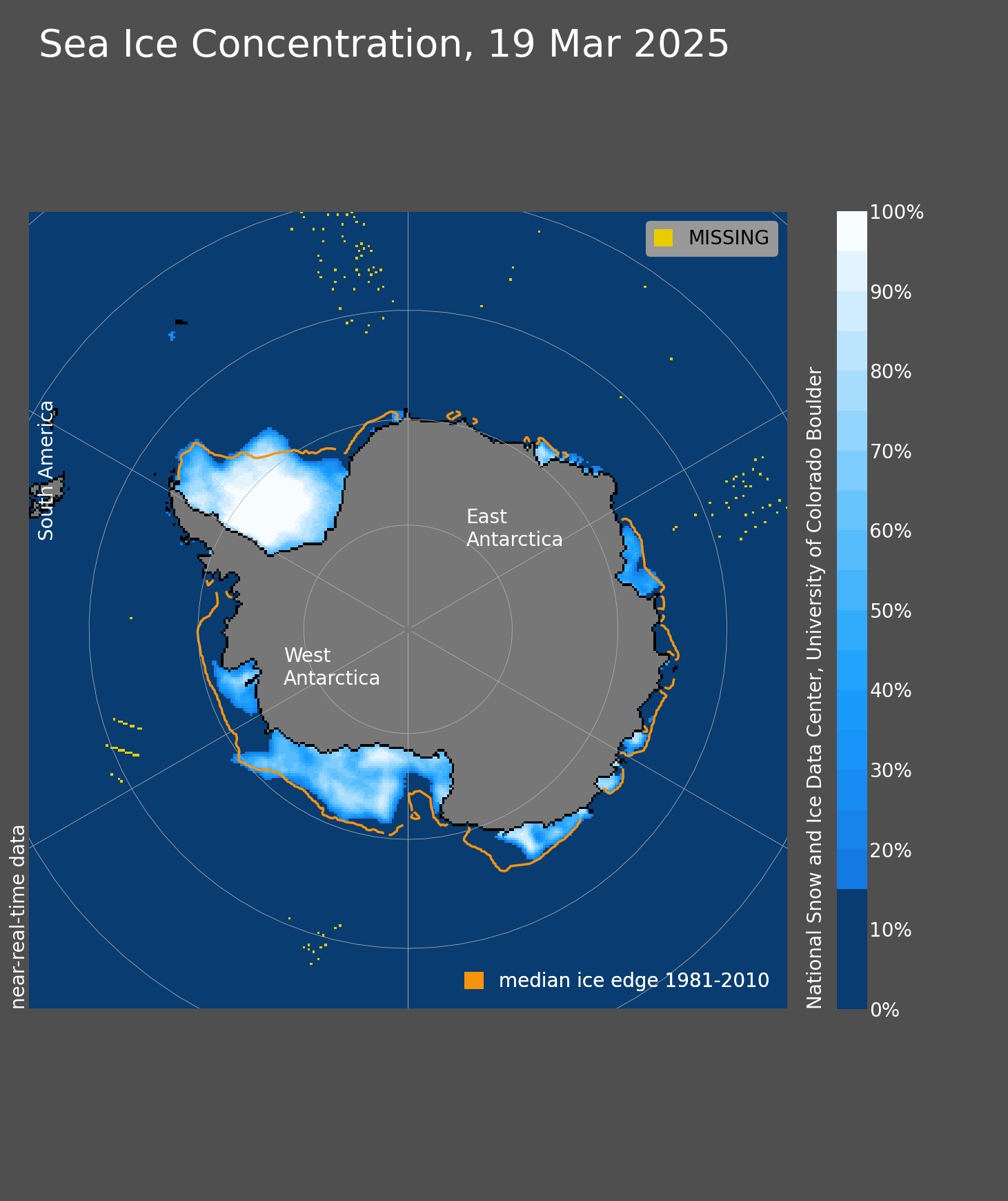
Sea ice concentration, June 14, 2026. (National Snow and Ice Data Center)
(ANTARCTICA) — A massive chunk of sea ice in West Antarctica has not refrozen following a winter heatwave in the region – a dramatic change that could further contribute to global sea level rise, experts told ABC News.
Graphics based on satellite imagery from the University of Colorado Boulder’s National Snow and Ice Data Center taken on Sunday show a large portion of sea ice measuring approximately 150,000 square miles – roughly the size of Montana – is not included in what is typically already frozen at this time of year, which is mid-winter in the Southern Hemisphere, experts told ABC News.
Every winter, Antarctic sea ice grows and decays, Peter Neff, a glaciologist at the University of Minnesota who specializes in ice core records, told ABC News. But since 2015, Antarctic sea ice has entered a “new, much reduced state,” in which less and less is re-freezing due to rising air and sea temperatures, Neff said.
This year, the level of sea ice in West Antarctica is about 50% lower than average, Neff estimated.
“This is a dramatic but not surprising observation in the context of the huge changes that have been occurring in Antarctica, particularly in this region of Antarctica, over the past decade,” Chuck Amsler, a professor of biology at the University of Alabama at Birmingham, told ABC News.
If the West Antarctica Ice Sheet were to collapse in its entirety, it has the potential to contribute more than 10 feet in sea level rise, according to a 2025 study by the International Thwaites Glacier Collaboration, a partnership between U.S. and U.K. agencies.
It is possible that this year’s June sea ice level in the area may surpass last year’s record low, Rose Malanga, a Ph.D. student at the University of Illinois Urbana-Champaign who conducted field research in Antarctica earlier this year, told ABC News. In June of both this year and 2025, the region had some of the lowest sea ice levels on record, Ellen Buckley, an assistant professor at the University of Illinois Urbana-Champaign’s Department of Earth Science and Environmental Change, told ABC News.
Data gathered by the Copernicus Earth observation program in June 2025 showed there was 12.6 million square kilometers of Antarctic sea ice, which is about 1.3 million square kilometers less than the 1991-2020 average.
Contributing factors likely include strengthening westerly winds, a phenomenon that’s connected to global warming due to climate change, as well as how the ocean is responding to those surface winds, Neff added.
A low-pressure anomaly north of the Bellingshausen Sea, which is adjacent to West Antarctica’s Antarctic Peninsula, is likely causing warm air from higher latitudes to warm the region and prevent sea ice formation, Buckley said.
“Winds drive how the ocean moves, but satellites can’t see into the ocean, so without being able to get down there, especially during the wintertime, we have very limited ability to do research,” he said.
The news of the lack of sea ice comes on the heels of above-average temperatures in the region, records show.
From January through April, the Bellingshausen Sea, where the ice would typically form, has seensea surface temperatures anywhere from 1.8 to 5.4 degrees Fahrenheit above average, according to National Oceanic and Atmospheric Administration data. Throughout May, the sea surface conditions cooled slightly but remained about 1.8 to 3.6 degrees Fahrenheit above average temperatures.
In June, the Bellingshausen Sea surface temperature varied by as much as 1.8 degrees Fahrenheit above normal. Air temperatures over the Bellingshausen Sea are forecast to be up to 18 degrees Fahrenheit above average from Tuesday through the weekend.
The area that has not yet refrozen is located upwind of the regions on the Antarctic Peninsula that just experienced this warming. The heat wave can contribute to the lack of sea ice extent because there is not reflective white ice surface to keep it cold, Neff said.
“With this kind of situation where there isn’t sea ice forming in the winter, that means in the spring there will be less sea ice to melt,” according to Buckley.
The question of why the Antarctic sea ice freeze and thaw cycle has been behaving differently in the last 10 years, compared to the previous 30 years, is a “huge area of research” right now, Neff said, especially in the western region of the continent, which is being monitored closely by scientists.
Glaciologists have taken a particular interest in Antarctica’s western shelf due to its potential to cause a severe rise in sea levels. Thwaites Glacier, also known as the “Doomsday Glacier,” already contributes to 4% of overall sea level rise, while Pine Island Glacier is one of Antarctica’s fastest-melting glaciers.
Deterioration of the remaining portion of the Thwaites Glacier’s floating ice shelf has been accelerating in recent months and is likely to break off in the coming weeks or months, Neff said, adding that while it won’t completely destabilize the glacier it will contribute significantly to global sea level rise.
The Antarctic Peninsula is warming about five times faster than the global average. The most severe heat event occurred in March 2022, when the continent recorded temperatures between 54 degrees and 72 degrees Fahrenheit above normal.
“The warm events are expected to be coming more frequently,” Neff said.
ABC News’ Kenton Gewecke and Sam Wnek contributed to this report.
The partially collapsed La Luna hotel after a magnitude 7.4 earthquake struck Colombia on Aug. 10, 2026, in Cali, Colombia. (Samir Rojas/Getty Images)
(LONDON) — At least 224 people are dead after a 7.4-magnitude earthquake rocked western Colombia on Monday, Colombia’s Public Ministry said.
The country’s new president, Abelardo de la Espriella, has declared a national disaster, with destruction reported in multiple cities.
The earthquake’s epicenter was 5 kilometers east of San José del Palmar, Colombia, according to the U.S. Geological Survey.
Along with the 224 dead, at least and 572 other have been injured, officials said.
The U.S. State Department said in a post on X that the Trump administration is committing $15.5 million for the Colombia earthquake response that will go towards emergency shelter, food, protection and earthquake assessments.
Some of the hardest-hit regions include the cities of Pereira and Cali. Dozens of people have been reported dead in their respective departments.
At least 61 buildings have collapsed and over 1,600 homes have been damaged or destroyed, the president said. Dozens of health centers, community centers and roads have also been damaged, he said.
In Cali, at least 20 buildings collapsed and people were trapped, according to the mayor. A rescue effort was ongoing in a building where at least 15 people were trapped, according to officials. A hospital in the city experienced severe damage, with one of the wings partially collapsing, and patients were being relocated, the local governor said.
The Mayor of Cali announced a curfew from 8 p.m. Monday to 6 a.m. Tuesday to “ensure safety in the city and to provide sufficient space and conditions for rescue workers to continue their efforts.”
The governor of Chuco said there were injuries and “severe damage” to buildings in the department’s capital city of Quibdo.
Seven airports have suspended their services, in the cities of Armenia, Cali, Manizales, Pereira, Quibdo, Buenaventura and Cartago.
There have not been any reports of collapsed buildings in the capital of Bogota, officials said.
The Monday morning earthquake was the strongest recorded in the country in a decade, according to the Colombian Geological Survey. It was widely felt throughout Colombia and in neighboring countries including Venezuela, Ecuador and Panama, it said.
The Colombian president said in a video on social media that he was headed to Bogota to “focus on addressing the emergency facing our country” and has convened a unified command post to respond to the affected areas, including what’s known as the Coffee-Growers’ Axis.
The Trump administration is “closely monitoring” the earthquake and stands “ready” to support the people of Colombia, Secretary of State Marco Rubio said in a statement.