Ohio voters are set to cast ballots in several key races in the state, including for governor as well as Senate and House seats.
It’s senator versus former senator in the race to fill the remainder of Vice President JD Vance’s Senate term. Incumbent Sen. Jon Husted, who has been in that role since 2025, faces former Sen. Sherrod Brown, who lost to Sen. Bernie Moreno in 2024. The winner of this race would be sworn in earlier than other members, potentially in December, and would be up for reelection in 2028.
The state also has a governor’s race with the retirement of Republican Gov. Mike DeWine. Vivek Ramaswamy, a 2024 Republican presidential candidate and businessman, faces off with former Ohio Department of Health Director Amy Acton, who ran the state’s COVID-19 response. The last time a Democrat won a governor’s race in Ohio was 20 years ago.
Ohio has several key U.S. House races. In the state’s 9th Congressional District, which has been redistricted to one President Donald Trump would have won by 11 points, Democratic Rep. Marcy Kaptur is running against Derek Merrin, a former state representative.
In the 7th Congressional District, allegations of domestic violence have put Republican Rep. Max Miller in a tough position in a deep red district. He denies all wrongdoing. He is running against Democratic candidate, Brian Poindexter, a union ironworker.
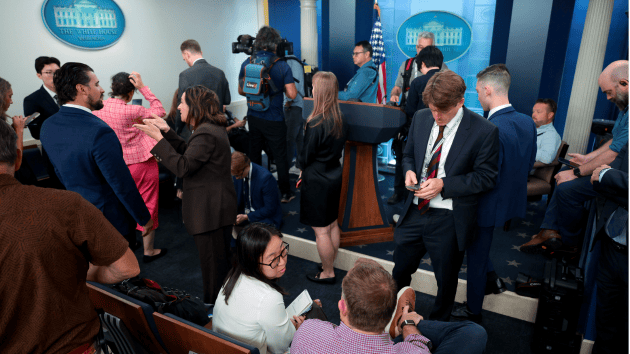
Journalists gather in the Brady Press Briefing Room before going into the Oval Office at the White House on September 18, 2026 in Washington, DC. (Photo by Chip Somodevilla/Getty Images)
(WASHINGTON) — Reporters for CNN, MS NOW and Politico say they were denied access to the White House grounds Saturday a day after President Donald Trump said the two news organizations and Politico were banned from the location.
“Media Outlets shouldn’t be able to constantly write or report FICTION and LIES when they’re covering the President of the United States, the Trump Administration, or the United States of America,” Trump said in a social media post Friday.
ABC News observed a CNN reporter and photographer being turned away from the White House security booth on Saturday.
The CNN photographer told ABC News that their passes were confiscated as he and the reporter exited the booth. The reporter flashed her now-empty ID card sleeve.
CNN later reported on air that a photographer and reporter were refused entry Saturday morning, with a reporter saying on CNN that she was told by a Secret Service agent that her badge had been deactivated.
In a statement, CNN said that it has “a right under the U.S. Constitution to do our reporting without hindrance or interference from the government and this ban is an illegal assault on this fundamental right.”
MS NOW released a statement Saturday that said some of its journalists were barred from entering the White House grounds.
“MS NOW intends to take any and all steps necessary to defend our First Amendment rights and the essential role of independent journalism in our democracy,” the network said in a statement. “We stand firmly behind our anchors, our reporters, and our newsroom.”
An MS NOW correspondent reported on air shortly after being denied that one MS NOW producer was able to enter the grounds.
“I asked, ‘We are both with the same network’ and [Secret Service] took a look at their computer — the two officers — and they said they weren’t sure what was going on, but at the end of the day they had to take my badge because it was disabled,” she said.
Politico’s Editor-in-Chief Jonathan Greenberger put out a statement Saturday that said a reporter was denied entry to the White House by Secret Service and her press credentials were taken away.
“We stand by her and all reporters here covering the White House. As we said yesterday, we will vigorously defend our First Amendment rights,” he said in his statement.
The White House did not immediately comment about the reporters’ access being denied.
MS NOW, CNN and Politico had earlier pushed back against the president’s move and vowed to continue their coverage.
The president said restrictions on other outlets would follow.
At an event in the Oval Office shortly after his post Friday, the president told reporters he supports a free press, but that “you need a fair and honest press.”
“It’s sick. I mean, there’s something wrong with a country that can allow people to write purposely negative stuff. Now, if they want to write them, that’s fine. But I don’t have to let them into my, into the people’s house,” Trump said.
In a statement Friday, CNN said it “stands fully behind our White House team and their fair and accurate reporting. We have a right under the U.S. Constitution to do that reporting without hindrance or interference from the government. Should the ban which President Trump threatened go ahead, it would be an illegal assault on that fundamental and constitutionally-protected right.”
Politico said Friday it “will continue to fairly report on this White House and future ones. We will vigorously defend our First Amendment rights against any attempt to restrict them.”
It also said that Trump’s claim Friday that the outlet received government subsidies “are false and have been thoroughly debunked.”
White House Correspondents Association President Jacqui Heinrich said in a statement Friday: “The president said it plainly in the Oval Office, describing his own planned action as a ‘ban on the free press.'”
“This is about more than the rights of journalists. It is about the right of the American people to receive a full and independent account of the activities, policies and decisions of whoever occupies the nation’s highest office,” she wrote.
Trump said he decided to make the announcement on Friday citing “cumulative stories.”
It is still unclear what exactly the ban means in practical terms.
Trump insisted he’s not trying to intimidate the press. “No, no, no, no,” he said, reiterating “I like to see honest press.”
The White House tried to ban then-CNN reporter Jim Acosta during Trump’s first term. CNN sued to restore Acosta’s press credentials and the White House later dropped its effort.
Earlier in this term, the Trump White House banned The Associated Press from participating in the pool that covers the White House because it refused to comply with his edict renaming the Gulf of Mexico to the Gulf of America. That case remains in litigation.
The Trump administration on Sunday filed another emergency appeal with the U.S. Supreme Court seeking to immediately implement new U.S. Postal Service mail ballot rules for November.
The application is not meaningfully different from the request the administration filed on Sept. 3, but comes in response to the federal judge handling the legal battle over new U.S. Postal Service mail ballot rules extending her block of the rules for the November midterm elections in an order issued on Friday, again finding them likely unlawful.
Judge Indira Talwani’s temporary order, which had been set to expire on Sept. 10, is now in place indefinitely unless the a higher court allows the Trump administration to put the rules into effect.
The judge found that immediate implementation of the rules this close to the November election, prompted by President Donald Trump’s executive order aimed at tightening access to mail ballots, “threatens disenfranchisement of millions of United States citizens who seek to vote by mail.”
Talwani concluded that the rules, which mandate nationwide mail ballot design and review requirements and state submission of a voter information database to USPS, are “unconstitutional where it intrudes not only on Congress’s Elections Clause powers but also that power left to the States.”
The decision ups the ante for the U.S. Supreme Court, which had already been asked to weigh in on Talwani’s preliminary injunction. A decision is expected as soon as the coming week.
Time is of the essence since some states have already begun mailing ballots for the fall election.
Trump, who has pushed unfounded claims of widespread mail ballot fraud, wants states to report to USPS basic voter information, such as a voter’s name and home address, attached to a unique barcode on every mail-in ballot distributed. Postal workers would then only deliver ballots addressed to voters who appear on the state-provided list.
Following the publication of the regulations last month, dozens of Democratic state attorneys general sued the Trump administration after an earlier lawsuit was blocked by the Supreme Court, which said at the time that the challenge was premature since the regulations hadn’t been finalized.
Judge Talwani wrote in her opinion Friday that the dispute was now ripe for judicial intervention.
“Nothing is hypothetical,” she said of the alleged harm to states, voters and voter advocacy groups ahead of the November election.
In its latest appeal to the justices, the Trump administration insisted the rules impose only “modest” ballot design and review requirements on states and that a requirement to submit name, address, and barcode information of intended recipients is not onerous or intrusive.
The states challenging the USPS rule have until Tuesday at 10 a.m. to formally respond before the Supreme Court makes a decision.
The states and voter advocacy groups have argued that the new USPS regulations are an attempt by the Trump administration to federalize elections, which are historically and constitutionally managed by each state, and make it harder to vote by mail for everyday citizens.
(WASHINGTON) — Janeese Lewis George won the Democratic primary for mayor of Washington, D.C., held earlier this week, according to a projection from the Associated Press on Thursday.
This is a developing story. Please check back for updates.