Rudy Giuliani hospitalized in critical condition: Spokesperson
Former New York City Mayor Rudy Giuliani attends the annual 9/11 Commemoration Ceremony on Sept. 11, 2025 in Manhattan. (Barry Williams/New York Daily News/Tribune News Service via Getty Images)
(NEW YORK) — Rudy Giuliani is hospitalized in critical condition, his spokesman said on Sunday.
The 81-year-old former New York City mayor is critical but stable, spokesman Ted Goodman said in a statement.
The statement does not say what led to the hospitalization.
“Mayor Rudy Giuliani is currently in the hospital, where he remains in critical but stable condition,” the statement said. “Mayor Giuliani is a fighter who has faced every challenge in his life with unwavering strength, and he’s fighting with that same level of strength as we speak. We do ask that you join us in prayer for America’s Mayor — Rudy Giuliani.”
Giuliani served as New York City’s mayor from 1994 to 2001.
More recently, he was a personal lawyer to President Donald Trump, who wrote about Giuliani’s hospitalization in a social media post. The president called Giuliani “a True Warrior, and the Best Mayor in the History of New York City, BY FAR.”
A spokesperson for Eric Adams, who was the city’s mayor from 2022 to 2025, noted Giuliani’s service in a statement.
“From his years as a federal prosecutor to leading New York City through its darkest day on 9/11, he stood with this city when it needed him most,” Adams spokesperson Todd Shapiro said.
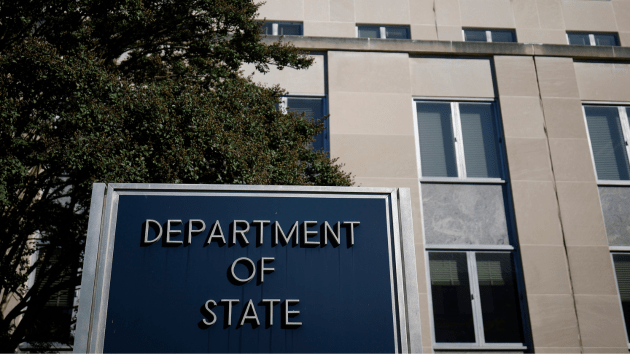
The Harry S. Truman Federal Building, headquarters of the U.S. Department of State, is pictured on October 08, 2024 in Washington, DC.
(WASHINGTON) — A federal judge on Friday struck down the Trump administration’s policy suspending immigrant visa issuance for nationals of 75 countries, setting aside refusals based solely on the policy and requiring those cases to be reconsidered by consular officers under the normal immigration laws.
U.S. District Judge Jeannette A. Vargas said the policy, announced by the State Department in January, “is contrary to law and was issued in excess of Secretary Rubio’s statutory authority.”
The directive instructed U.S. embassies and consulates to suspend immigrant visa adjudications while the State Department reassessed its vetting procedures under existing immigration law.
The State Department said in January the pause was intended to “prevent the entry of foreign nationals who would take welfare and public benefits.”
Vargas said Friday the policy conflicts with federal immigration law, which gives consular officers “exclusive authority and discretion” to determine whether an immigrant is eligible for a visa.
“The Policy, which categorically prohibits the issuance of immigrant visas based upon the nationality of the applicant, represents a direct abrogation of this statutory scheme,” Vargas wrote.
The judge’s order also vacates visa denials that were based solely on the policy.
“The suspension of lawful visa processing across 75 countries separated spouses, parents, and children who were simply following the legal immigration process,” said Anna Gallagher, executive director of the Catholic Legal Immigration Network Inc., the group that filed the lawsuit challenging the policy.
“Catholic social teaching calls us to uphold the dignity of every person and recognize the family as the foundation of society,” Gallagher added. “Today’s decision affirms both those values and the rule of law, allowing families to once again move forward toward reunification.”
The State Department did not immediately respond to ABC News’ request for comment, nor has it indicated it is going to appeal the decision.
“The Trump administration is bringing an end to the abuse of America’s immigration system by those who would extract wealth from the American people,” a State Department spokesman said in a statement when the policy was announced. “The State Department will use its long-standing authority to deem ineligible potential immigrants who would become a public charge on the United States and exploit the generosity of the American people.”
Senate Finance Committee Chairman Charles Grassley (R-IA), Sen. John Cornyn (R-TX) and Senate Majority Leader John Thune (R-SD) attend a Finance Committee hearing on July 30, 2026, in Washington, DC. Cornyn is withholding support for President Donald Trump’s nominee for U.S. attorney general, Todd Blanche, until he gets reassurances on Trump’s IRS lawsuit settlement and the elimination of the “anti-weaponization fund.” (Photo by Win McNamee/Getty Images)
(WASHINGTON) — President Donald Trump on Thursday floated the possibility of temporarily withdrawing Todd Blanche’s nomination for attorney general as his confirmation is being held up by two outgoing Republican senators.
“Todd Blanche is a STAR, and everyone knows it! He has the potential to go down as one of the Greatest Attorney Generals of All Time. However, John Cornyn, of Texas, and Thom Tillis, of North Carolina, both of whom I refused to Endorse, and whose political careers have been ended by my action, are refusing to vote for this Great Nominee, who will remain, in any event, as Acting,” Trump wrote in a social media post.
“I have no objection to temporarily withdrawing Todd’s name, if they do not do the right thing, and putting him back after Cornyn and Tillis are out of office,” Trump wrote.
Earlier Thursday morning, Cornyn said there were “new complications” in the standoff.
Cornyn is demanding the Department of Justice put in writing that the nearly $1.8 billion so-called “Anti-Weaponization Fund” is officially dead, and that the scope of President Trump’s immunity deal with the IRS be narrowed.
“I know that Todd Blanch understands it, but I think he’s probably getting some pushback from the White House, and that’s making things more complicated than there needs to be,” Cornyn told ABC News.
This is a developing story. Please check back for updates.
The Lincoln Memorial reflecting pool along the National Mall on Tuesday, July 3, 2026 in Washington, D.C.Rushed work continues at the White House and across the nation’s capital in preparation for the country’s 250 anniversary on July 4. (Photo by Finn Gomez/Getty Images)
(WASHINGTON) — pleaded not guilty through his attorney to the felony charge he faces for allegedly damaging the Lincoln Memorial Reflecting Pool.
This is a developing story. Please check back for updates.