The U.S. Department of Justice Building on Aug. 17, 2026, in Washington, D.C. (Anna Moneymaker/Getty Images)
(WASHINGTON) — A federal judge overseeing a lawsuit against the Justice Department said at a hearing Friday that she remains skeptical that the Trump administration won’t move forward with improperly compensating allies of President Donald Trump who were prosecuted under the Biden administration, despite the DOJ’s repeated statements that the $1.8 billion “Anti-Weaponization Fund” is dead.
This is a developing story. Please check back for updates
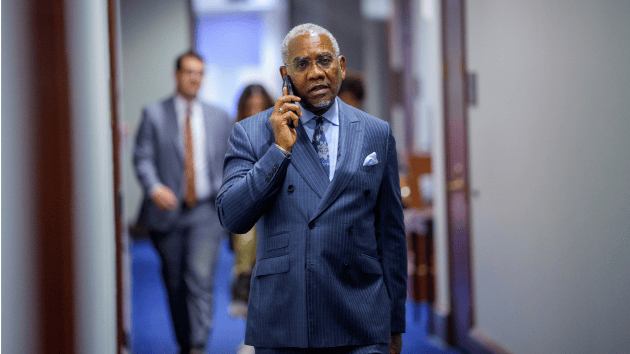
Rep. Gregory Meeks (D-NY) arrives for a Democratic caucus meeting on Capitol Hill on September 1, 2026 in Washington, DC. (Photo by Andrew Harnik/Getty Images)
(WASHINGTON) — Democratic lawmakers are pushing a bill to disapprove of a nuclear cooperation agreement struck between the United States and Saudi Arabia in a bid to strike down the proposal during a three-month period of congressional review.
Democratic Reps. Gregory Meeks, the top Democrat on the House Foreign Affairs Committee, along with Brad Sherman, John Garamendi and Don Beyer introduced a Joint Resolution of Disapproval on Wednesday, shortly before lawmakers left Washington to return home ahead of midterm elections. A vote could come in November, after the midterms.
Without a two-thirds vote, President Donald Trump could veto Meeks’ bill and the nuclear deal would take effect as it is written.
The nuclear deal, known as a 123 agreement, paves the way for American industry to collaborate on tens of billions of dollars of nuclear energy projects in the kingdom in what the administration says is a sign of deepening ties between the U.S. and Saudi Arabia.
The agreement has raised concerns around the proliferation of technologies that could support a Saudi effort to weaponize nuclear energy, security experts and members of Congress have said.
The terms of the agreement break from the so-called “gold standard” for nuclear deals, by which countries allow international inspectors widespread access to facilities that could support nuclear development. Inspectors are also allowed access to undeclared sites — activities that could involve research that would contribute to nuclear energy.
The U.S.-Saudi deal instead includes a narrower agreement that would limit inspections, administered by the International Atomic Energy Agency, to only declared nuclear sites.
The text of the agreement, which has been released publicly by the administration, establishes a joint study between the two countries on the feasibility of an enrichment facility on Saudi Arabian soil. An additional study could open the door to enrichment of uranium of up to 20%.
Kelsey Davenport, the director for nonproliferation policy at the Arms Control Association who has reviewed the text, said that study was described “vaguely” in the signed agreement.
Enrichment to 20% “poses a more significant risk because enriching to that level constitutes the majority of work necessary to enrich to weapons-grade levels, or 90%,” Davenport said. “The United States has repeatedly, and rightly, raised concerns about Iran previously enriching to the 20 percent level.”
Saudi Arabian Crown Prince Mohamed bin Salman, the kingdom’s de facto leader, has in the past said his government would seek a nuclear weapon if Iran managed to acquire one.
In its communication to Congress on Aug. 27, the Trump administration acknowledged the Crown Prince’s “concerning public statements.”
Secretary of State Marco Rubio, defending the deal in July, said that Saudi Arabia could have turned to an American adversary, like China or Russia, had the U.S. not been prepared to sign the nuclear agreement.
“We live in a new era,” he said. “There are competitors that we face, so we’ll have to adjust individual deals to that reality. We’re not the only show in town but we’re the best show in town. But we want to be, we want to make sure that it’s our companies they’re picking.”
In a letter to Rubio and Energy Secretary Chris Wright Wednesday, a group of lawmakers called for the administration to declassify two documents, or “side letters,” which the White House said were part of the deal but could not be released.
The lawmakers, which included Republican Sens. John Kennedy Louisiana and Rand Paul of Kentucky, called for their release, adding they were “aware of no precedent for classifying and withholding the side letters, particularly when the stated purpose is peaceful nuclear cooperation.”
A bill to strike down the Saudi deal, requiring a supermajority in the Republican-controlled Congress, is exceedingly unlikely. But lawmakers could also opt to pass a law that applies certain conditions to the nuclear agreement.
US President Donald Trump speaks to reporters after landing in Air Force One on July 19, 2026 in Joint Base Andrews, Maryland. (Andrew Harnik/Getty Images)
(WASHINGTON) — The new Air Force One will be “maxed out” with security features, undergoing an upgrade that’s expected to put the Qatari-gifted jet out of commission for about a month, President Donald Trump said on Sunday.
“Well, it has, it has a lot, and you know it has a lot of capability, but as I understand it, in about a month or so, they’re going to send it to have it be maxed out,” the president said of the newly retrofitted jet. “So they’re going to be sending it, and they’ll have it be maxed out.”
The jet had faced security concerns in the weeks since its first operational flight on July 1, when Trump flew on it to North Dakota. The plane, a Boeing 747-8 that was gifted from Qatar, later carried Trump to the NATO summit in Turkey this month.
As Trump prepared to depart the summit, the Secret Service urged the president to take the older Air Force One jet as a precaution, due in part for the differences in security capabilities, ABC News learned at the time.
The New York Times reported that the new jet did not have the same anti-missile capabilities as the previous model. Trump’s comment on Sunday followed a reporter’s question about those claims, which ABC News has not independently confirmed.
“Mr. President, this plane does not have antimissile defense systems on it,” the reporter asked. “Why are you flying on it?”
Trump in response said the plane would be “maxed out,” a process that he expected would “take about a month.” The president did not detail exactly when the upgrades were expected to begin.
The Qatari royal family’s donation of the luxury jet valued at approximately $400 million, an unprecedented foreign gift, raised questions from some lawmakers and ethics experts. Ahead of his first flight, Trump gave credit to the Qatari government.
“Frankly, we couldn’t build a plane like this because we wouldn’t be willing to spend the kind of money necessary,” he said on July 1. “They spent top dollar.”
“I said to Boeing, ‘What’s the best one?’ They said this is the best plane ever built, and you’re going to have the privilege of flying it, and I have a privilege also of flying it,” Trump said that day.
The U.S. Air Force said it had been modifying the jet Texas since September to meet the security, communications and other needs to transport the president.
The Air Force last year originally estimated it would cost less than $400 million to retrofit the gift, though it’s unclear how much exactly has been spent so far. Many of the details of the retrofitting on the new plane are considered classified.
The gifted plane is expected to be used as the new Air Force One until shortly before Trump leaves office, at which time ownership of the plane will be transferred to the Donald J. Trump Presidential Library Foundation, sources familiar with the proposed arrangement have told ABC News.
ABC News’ Emily Chang, Sarah Kolinovsky and Michelle Stoddart contributed to this report.
Democratic Senate candidate James Talarico speaks during a “Talarico for Texas: Frontera Tour” campaign rally at the La Posada facility, July 14, 2026, in Laredo, Texas. Brandon Bell/Getty Images
(WASHINGTON) — Democrats raised more money than their Republican opponents in key Senate races across the country in the second quarter, according to campaign finance filings made this week to the Federal Election Commission.
In Georgia, Democratic Sen. Jon Ossoff raised almost ten times what Republican Rep. Mike Collins did. In Ohio, Democrat Sherrod Brown outraised Republican Sen. Jon Husted by roughly $10 million. In Texas, Democrat James Talarico outraised Republican Ken Paxton by over $26 million.
Talarico’s haul marks a new record for second quarter fundraising, far surpassing other Democrats who previously pursued Senate seats in Texas.
At this point in Beto O’Rourke’s 2018 campaign, O’Rourke had raised a grand total of just under $24 million since the start of the election cycle. MJ Hegar had raised $6.6 million in 2020, and Colin Allred had raised over $38 million in 2024. All three of those Democratic candidates ultimately lost their general election fights.
Talarico has raised nearly $69 million this cycle, and the candidate still has over $21 million to spend. Lone Star Rising, a super PAC that supports Talarico, raised $12.7 million in the second quarter, most of it from LinkedIn co-founder Reid Hoffman.
Talarico’s opponent, Paxton, who is currently serving as the state’s attorney general, raised $2.2 million in the second quarter and has around $1.8 million in the bank, according to filings.
Lone Star Liberty, a super PAC that supports Paxton, raised about $4.3 million. They have about $35,000 cash on hand.
Republican PACs remain well-stocked, and Elon Musk contributions grow
Still, there are reasons for Republicans to be optimistic as the general election approaches.
In some cases, Republicans still have more money saved. Alaska Democrat Mary Peltola outraised her opponent, Republican Dan Sullivan, by nearly $5 million. But Sullivan spent little (under $1 million) in the second quarter, and still has more than $8 million on hand, according to FEC filings. That puts him $1 million ahead of Peltola.
Republican super PACs and party committees are also well-resourced. The Senate Leadership Fund, a flagship Republican super PAC affiliated with Senate Majority Leader John Thune, outraised its Democratic equivalent, the Senate Majority PAC, by nearly $20 million.
The National Republican Senatorial Committee (NRSC) reported having a cash on hand lead of over $10 million on the Democratic Senatorial Campaign Committee (DSCC) when those groups filed their most recent monthly reports. The Republican National Committee (RNC) has over $125 million in the bank, while the Democratic National Committee (DNC) is in debt.
MAGA Inc., a Donald Trump-affiliated super PAC, had over $382 million on hand when its most recent monthly report was filed.
Among MAGA Inc.’s donors is Elon Musk, who has emerged as one of the Republican party’s top supporters this midterm cycle despite past spats with Trump. He has invested at least $90 million dollars, including a recent $5 million donation, to Vivek Ramaswamy’s super PAC, V-PAC. Ramaswamy is running for Ohio governor against Amy Acton. Musk also endorsed Ramaswamy, which comes after notable tension between the two when co-leading the Department of Government Efficiency.
Musk’s own super PAC, America PAC, has kept a relatively low profile since last year, when Brad Schimel, Musk’s preferred candidate in a Wisconsin Supreme Court race, lost in a 10-point blowout. America PAC and other Musk-affiliated groups spent millions supporting Schimel.
Democrats face internal struggles in Michigan and Maine
Democrats also face challenges internally. In Michigan, two Democratic Senate candidates are still locked in a hard-fought primary, vying for the opportunity to challenge Republican Mike Rogers. Abdul El-Sayed, a progressive candidate endorsed by Sen. Bernie Sanders, raised $4.6 million, while Rogers raised under $3 million. Rep. Haley Stevens raised about $2.1 million, according to FEC filings. Rogers has more cash on hand, $5.7 million, than either of his potential Democratic opponents.
In Maine, Democrat Graham Platner’s campaign raised over $9 million, while Republican Sen. Susan Collins’ campaign raised around $5.7 million. Collins has far more cash on hand however, $11 million compared to the Platner campaign’s $1.8 million.
Given that Platner dropped out of the race earlier this month in the wake of a sexual assault allegation, which he’s denied, it is still unknown if and how Democrats will access the Platner campaign’s war chest to benefit whoever his replacement turns out to be. Candidate-to-candidate transfers are limited to $2,000.