Suspect in Minnesota political killings will not face death penalty: DOJ
A vehicle belonging to Vance Boelter is towed from the alley behind his home on June 14, 2025 in Minneapolis, Minnesota. (Stephen Maturen/Getty Images)
(WASHINGTON) — Federal prosecutors will not seek the death penalty against Vance Boelter, the man charged in the 2025 fatal shooting of a Minnesota state representative and her husband, and another attack that left a second lawmaker and his wife wounded, according to a Department of Justice spokesperson.
Prosecutors declined to pursue the ultimate punishment against 58-year-old Boelter because a federal judge ruled earlier this year in an unrelated murder case that interstate stalking charges do not rise to the level to support a capital crime, officials said.
This is a developing story. Please check back for updates.
Daughter of former FBI Director James Comey, Maurene Comey, leaves the Albert V. Bryan United States Courthouse on November 13, 2025 in Alexandria, Virginia. (Alex Wong/Getty Images)
(NEW YORK) — A federal judge in New York on Tuesday blocked the Justice Department’s attempt to move Maurene Comey’s lawsuit over her firing as a federal prosecutor out of court.
Comey, the daughter of former FBI director James Comey, has joined a private law practice but is suing for unlawful termination after she was fired last year from the U.S. Attorney’s Office for the Southern District of New York.
The Justice Department argued that her case belongs before the Merit Systems Protection Board and not in federal district court.
Judge Jesse Furman decided the case belongs with him because Comey was fired pursuant to the president’s executive authority and not the usual procedures for civil servants.
“Maurene Comey was, by all accounts, an exemplary Assistant United States Attorney. In her nearly ten years working at the United States Attorney’s Office for the Southern District of New York, she was assigned some of the country’s highest profile cases, and she consistently received the highest accolades from supervisors and peers alike,” the judge’s opinion said.
“Comey was notified by email from Department of Justice officials in Washington, D.C., that her employment was terminated, effective immediately,” the judge wrote. “She was given one and only one reason for her removal: Article II of the U.S. Constitution, which ‘vest[s]’ the ‘executive Power’ in the President.”
The DOJ, in court filings, has characterized Comey’s case as routine.
“A federal employee’s claims that removal from federal service was arbitrary and capricious or conducted in a manner that did not provide the process to which they contend they were due is not a novel issue,” government attorneys said.
Comey, who prosecuted high-profile defendants including Sean Combs, Robert Hadden, Jeffrey Epstein and Ghislaine Maxwell, alleged she was fired “because her father is former FBI Director James B. Comey, or because of her perceived political affiliation and beliefs, or both.”
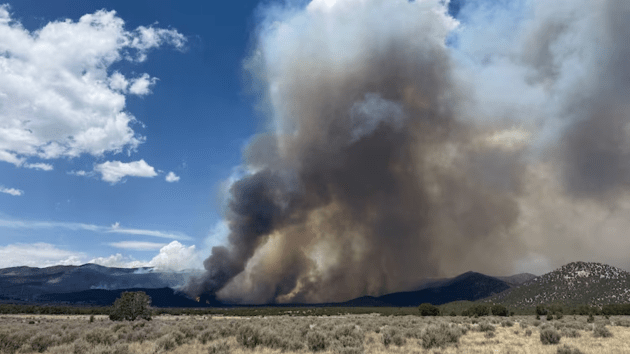
The Iron Fire burning in Northern Utah is threatening structures in the town of Eureka, where a mandatory evacuation order was in effect, June 21, 2026. (Utah Fire Info)
(EUREKA, Utah) — Mandatory evacuations are underway for hundreds of people on Sunday in a central Utah town being threatened by a wind-driven, out-of-control wildfire, officials said.
The Iron Fire is burning in Juab County, about 28 miles southwest of Provo, and officials said on Sunday that flames are bearing down on Eureka, Utah, a small town in the East Tintic Mountains.
The wildfire, which started on Friday night, had burned more than 13,300 acres by Sunday morning and remains 0% contained, according to Utah Fire Info.
The wildfire, according to Utah Fire Info, was human-caused, but details of what sparked the blaze have not been released.
Shifting winds and dry vegetation fueled the wildfire on Saturday and sent it in the direction of Eureka, where authorities issued mandatory evacuation orders on Saturday. Fire officials said flames were threatening “numerous structures” in the area.
The fire rapidly grew from about 5,000 acres on Saturday to more than 13,000 overnight.
“That’s way closer than anybody wants it to be,” Daylan Hermanson, a Eureka resident, told ABC Salt Lake City affiliate station KTVX, as he watched flames creep over a mountainside headed for Eureka.
Kelly Wicken, a spokesperson for the Utah Division of Forestry, said the blaze started on private land and has now spread across Juab and two other counties, crossing onto federal land and shutting down a highway.
Before the fire, the National Weather Service had issued red flag fire danger warnings for a large part of the state.
Utah is also in the middle of a severe drought that has dried out vegetation, providing fuel for any fires.
“With June temperatures rising, Utah is facing a deepening drought that has accelerated the drying of soils and vegetation across the state,” the Utah Department of Natural Resources said in a June 11 statement. “Wildfire season has already been active with over 230 fires so far this year, a majority of which were human-caused.”
The Iron Fire is the biggest of 11 wildfires that have ignited across the state since Friday.
The Hastings Fire, which started on Saturday west of Salt Lake City, had burned 2,500 acres by Sunday morning and was 0% contained, according to Utah Fire Info.
The Middle Fork Fire near Ogden and the Boonville Fire, just east of the University of Utah campus in Salt Lake City, had both burned more than 300 acres since starting on Saturday and were both 0% contained on Sunday.
“Utah is facing multiple wildfires across the state today, and we are using every available resource to support response efforts,” Utah Gov. Spencer Cox said in a social media post on Saturday evening. “Conditions remain dry and dangerous. Please use extreme caution, follow evacuation notices, and do your part to prevent new fires.”
A Tesla crashed into the outdoor dining area of an Urbane Cafe in Simi Valley, California, on Monday afternoon, killing one person and injuring five others, authorities said. (KABC)
(SIMI VALLEY, Calif.) — A car crashed into the outdoor dining area of an Urbane Cafe in Simi Valley, California, on Monday afternoon, killing one person and injuring five others, authorities said.
The crash was reported at about 2:30 p.m. near Tierra Rejada and Madera roads in a busy shopping center, according to Simi Valley Police.
Aerial footage from ABC News Los Angeles station KABC showed a white Tesla lodged in the restaurant’s outdoor patio after the collision.
One person was pronounced dead at the scene, while five others suffered minor injuries, according to the Ventura County Fire Department.
Authorities have not released the identity of the person who died, and additional information about the victims was not immediately available.
Investigators said they are still working to determine the cause of the crash. The Tesla driver was a 64-year-old woman with four juvenile passengers in the car, police told KABC.
The driver and one passenger were taken to a hospital for minor injuries, according to KABC.
“We’re still trying to determine if speed was involved. We do know that the Tesla was going northbound through the parking lot. It was attempting to make a right-hand turn to go eastbound toward Madera and, unfortunately, did not make the turn and went over the sidewalk when it struck the female victim,” Simi Valley police Sgt. Rick Morton told KABC.
Earlier this month, a Tesla Model 3 crashed into a home in Katy, Texas, killing a woman. Her family has since filed a lawsuit against Tesla and the driver, alleging the vehicle’s driver-assistance technology contributed to the crash.
Tesla has disputed those claims, saying the driver manually overrode the system by pressing the accelerator. Federal safety officials are investigating the crash.
Authorities have not said whether any driver-assistance technology was engaged at the time of Monday’s crash.
“We don’t believe it was an intentional act, but until we can determine what the cause was, whether it was mechanical failure or there was impairment by the driver, it’s still to be determined,” Morton said.