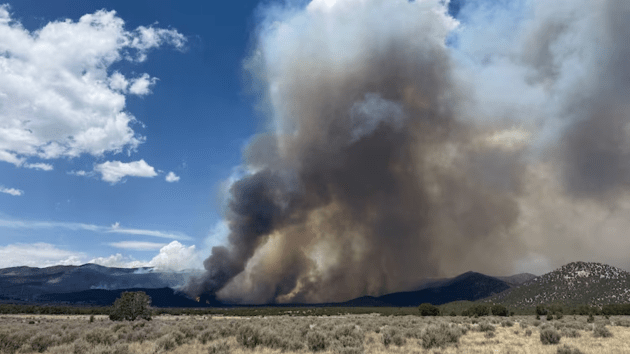
Raging Utah wildfire prompts evacuation as crews struggle to contain it: Officials
The Iron Fire burning in Northern Utah is threatening structures in the town of Eureka, where a mandatory evacuation order was in effect, June 21, 2026. (Utah Fire Info)
(EUREKA, Utah) — Mandatory evacuations are underway for hundreds of people on Sunday in a central Utah town being threatened by a wind-driven, out-of-control wildfire, officials said.
The Iron Fire is burning in Juab County, about 28 miles southwest of Provo, and officials said on Sunday that flames are bearing down on Eureka, Utah, a small town in the East Tintic Mountains.
The wildfire, which started on Friday night, had burned more than 13,300 acres by Sunday morning and remains 0% contained, according to Utah Fire Info.
The wildfire, according to Utah Fire Info, was human-caused, but details of what sparked the blaze have not been released.
Shifting winds and dry vegetation fueled the wildfire on Saturday and sent it in the direction of Eureka, where authorities issued mandatory evacuation orders on Saturday. Fire officials said flames were threatening “numerous structures” in the area.
The fire rapidly grew from about 5,000 acres on Saturday to more than 13,000 overnight.
“That’s way closer than anybody wants it to be,” Daylan Hermanson, a Eureka resident, told ABC Salt Lake City affiliate station KTVX, as he watched flames creep over a mountainside headed for Eureka.
Kelly Wicken, a spokesperson for the Utah Division of Forestry, said the blaze started on private land and has now spread across Juab and two other counties, crossing onto federal land and shutting down a highway.
Before the fire, the National Weather Service had issued red flag fire danger warnings for a large part of the state.
Utah is also in the middle of a severe drought that has dried out vegetation, providing fuel for any fires.
“With June temperatures rising, Utah is facing a deepening drought that has accelerated the drying of soils and vegetation across the state,” the Utah Department of Natural Resources said in a June 11 statement. “Wildfire season has already been active with over 230 fires so far this year, a majority of which were human-caused.”
The Iron Fire is the biggest of 11 wildfires that have ignited across the state since Friday.
The Hastings Fire, which started on Saturday west of Salt Lake City, had burned 2,500 acres by Sunday morning and was 0% contained, according to Utah Fire Info.
The Middle Fork Fire near Ogden and the Boonville Fire, just east of the University of Utah campus in Salt Lake City, had both burned more than 300 acres since starting on Saturday and were both 0% contained on Sunday.
“Utah is facing multiple wildfires across the state today, and we are using every available resource to support response efforts,” Utah Gov. Spencer Cox said in a social media post on Saturday evening. “Conditions remain dry and dangerous. Please use extreme caution, follow evacuation notices, and do your part to prevent new fires.”
Vilbrun Dorsainvil told ABC News he is “scared” of going back to Haiti. (Courtesy of Vilbrun Dorsainvil)
(NEW YORK) — Marlene Noble, 35, has lived more than 30 years of her life in the United States.
After being abandoned by her biological family after a hurricane hit her home country of Haiti, she was brought by Catholic Charities to the United States, where she was later adopted.
But when she turned 18, she learned that her adoptive family had not properly submitted the adoption and immigration paperwork, leaving her in legal limbo.
She spent years trying to fix her status — including filing for citizenship on her own in her mid‑20s and consulting multiple lawyers — before eventually applying in 2020 for Temporary Protected Status, which she was granted in 2023.
But now, Noble finds herself again facing uncertainty as the Trump administration’s move to end TPS — which provides work authorization and protection from deportation to people whose home countries are deemed unsafe — faces a high‑stakes test at the Supreme Court amid the administration’s immigration crackdown.
“America is my home, and it has been for 31 years,” Noble told ABC News. “It took three years for me to get granted TPS. So a lot of hard work went into this, just to have it potentially ripped away from me … It’s kind of cruel and inhumane to rip that away from us.”
Noble says she is “scared” about Wednesday’s Supreme Court hearing, where the justices will consider whether the administration acted unlawfully in seeking to terminate TPS for Haitians and other groups.
The outcome could directly affect the futures of tens of thousands of TPS holders from Haiti and Syria.
In a statement to ABC News, a spokesperson for the Department of Homeland Security said TPS was “never intended to be a de facto asylum program, yet that’s how previous administrations have used it for decades.”
“The Trump administration is restoring integrity to our immigration system to keep our homeland and its people safe, and we expect a higher court to vindicate us in this,” the spokesperson said. “We have the law, the facts, and common sense on our side.”
In previous statements, DHS has also argued that, after reviewing country conditions and consulting with other U.S. government agencies, the DHS secretary determined that Haiti no longer meets the conditions for TPS designation.
But immigrant advocates and plaintiffs in the case argue that Haiti is not safe. They point to the State Department’s “do not travel” advisory that warns Americans not to go to Haiti because of gang violence, kidnapping and political instability. And just last week, the Federal Aviation Administration extended its ban on U.S. aircraft operating in and near Haiti due to safety concerns.
“The State Department advises people to do not go there,” said Vilbrun Dorsainvil, the lead plaintiff in the Supreme Court case. “They know for sure that if we get back we will get killed, kidnapped.”
Dorsainvil, a former doctor in Haiti and currently a registered nurse in Springfield, Ohio, told ABC News that when he found out the Trump administration canceled TPS, he “stayed home for, like, for more than two weeks without going outside.”
“I was very scared of what might happen to me,” he said. “I didn’t go to work, I didn’t go to church, you know, visit any friends. I just stayed home because I was very scared that they would take me.”
Dorsainvil said he arrived in the U.S. in March 2021 on a tourist visa and then later was approved for TPS status.
“I bought a house. I have a mortgage,” he said. “I help a lot of people getting better in the hospital. I love the job I’m doing. I am useful here.”
“The idea of going back there right now is scaring me, it’s killing me inside,” Dorsainvil said. “I hope they will see the good we are bringing to the community. I hope they will see the situation in Haiti right now … it’s not safe for anyone … and I pray they would let us stay here.”
While Wednesday’s arguments will focus on the TPS status of Haitians and Syrians, the high-profile case has cast a ripple across other communities who fear they might be the next population to lose their status.
Anil Shahi, a TPS holder from Nepal, said he plans to protest outside the Supreme Court on Wednesday on behalf of the 1.3 million people who rely on TPS. A founding coordinator for United for TPS Nepal — an organization that represents more than 1,400 TPS holders from that country — Shahi said that the Trump administration’s revocation of TPS status has forced TPS holders to live in a state of uncertainty about their legal status.
“The uncertainty is a huge killer. It’s very painful. You don’t know what’s going to happen … you’re scared,” he told ABC News. “You cannot just pick up and leave.”
DHS designated Nepal for TPS in 2015 following a devastating 7.8-magnitude earthquake in the country that resulted in more than 8,800 deaths. The Trump administration sought to terminate the country’s TPS status in June 2025, though the change is the subject of an ongoing legal challenge.
According to Shahi, many Nepali TPS holders fear what might come next, in part because their personal information is readily available to authorities. With TPS recipients being vetted every 18 months, their addresses and personal data are known to the federal government.
“The government knows where we live. They know where we work. They have everything documented, right?” Shahi said. “So we are like a low-hanging fruit for them. It’s really easy for them to come after us if they really wanted to. And that’s what makes people really scared.”
Shahi said that Nepali TPS holders will be anxiously awaiting news from the Supreme Court, believing the outcome of Wednesday’s oral argument could indicate how their own legal fight will end.
At 56 years old, Shahi has lived the majority of his life in the United States and said he can’t imagine relocating to Nepal. He said that many Nepali TPS holders have U.S.-born children, and more than a hundred members of United for TPS Nepal own small businesses like restaurants, convenient stores, and beauty salons.
“I felt like I was a foreigner in my own country,” Shahi said about the last time he visited Nepal. “That was the point I realized I’m like really American, more than Nepali.”
A dog was shot by a police officer inside this condo building on Jordan Avenue, in Los Angeles. (KABC)
(LOS ANGELES) — The Los Angeles Police Department said it’s investigating an incident in which an officer shot and killed a dog while answering a 911 call, which turned out to be a false alarm over a woman celebrating the New York Knicks’ historic championship win on Saturday.
LAPD Chief Jim McDonnell said in a statement Wednesday that the department is thoroughly investigating the incident, which he called “incredibly tragic,” and vowed transparency.
Around 8:55 p.m. Saturday, officers responded to a 911 call of a woman screaming inside a condo in Canoga Park, the LAPD said.
The LAPD said that while officers were speaking with a resident in the apartment at the center of the 911 call, a “large dog was barking by her side at the officers.” The dog was wearing a Knicks shirt, witnesses told KABC.
The woman closed her door momentarily after officers asked her to secure the dog, who was named Jameson, police said. After she reopened it, the dog exited the apartment and allegedly “charged at one of the officers,” prompting one of them to open fire, according to the LAPD.
Cell phone video circulated online of a woman crying over the dog’s body, shouting “We were just celebrating the Knicks.”
The neighbor who called police told KABC that they felt guilty about calling 911, but sincerely thought the woman was in trouble.
McDonnell sympathized with Jameson’s family.
“The loss of a pet is deeply personal. For many, a dog is not simply an animal; it is a companion, a source of comfort, and a member of the family,” McDonnell said in his statement.
“There is no incident more serious than when an officer fires a service weapon. For this reason, the LAPD has a specialized division of investigators specifically trained to handle these types of incidents. A thorough, multi-layered examination of this weekend’s incident in Canoga Park is already underway, but it will take time to ensure fairness, transparency, and accountability,” he added.
A memorial for Jameson was formed outside the condo and an online fundraiser has raised thousands of dollars for its family.
Local activists have called for more details about the incident, including body camera footage from the officers who responded to the call.
“The tragic killing of Jameson was unnecessary and unwarranted,” Najee Ali, a senior organizer with the Los Angeles National Action Network, said during a news conference Tuesday.
“We demand immediate accountability, which can only happen through the prompt release of the body-worn camera footage and the names of the officers responsible for shooting and killing Jameson,” he added.
Los Angeles Mayor Karen Bass also released a statement on Wednesday, saying that a thorough investigation will be conducted.
“Every life lost to violence is a tragedy, and we know that the devastating loss of Jameson will be felt by his family forever,” she said.