Former CIA Director John Brennan sues Trump, others to preserve records from investigations
Former Director of the Central Intelligence Agency John O. Brennan is seen on October 24, 2022 in Philadelphia, Pennsylvania. (Gilbert Carrasquillo/GC Images)
(WASHINGTON) — Former CIA Director John Brennan on Wednesday sued President Donald Trump and his top law enforcement officials to force them to preserve records related to investigations into Brennan.
This is a developing story. Please check back for updates.
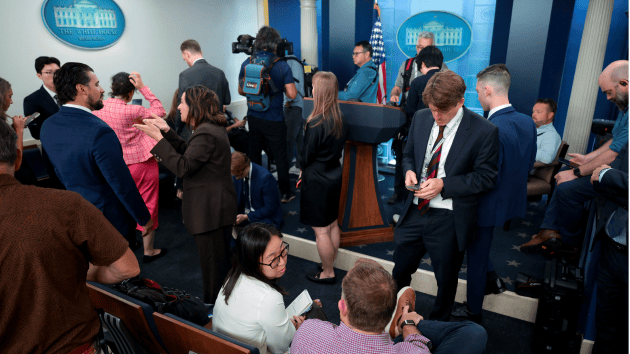
Journalists gather in the Brady Press Briefing Room before going into the Oval Office at the White House on September 18, 2026 in Washington, DC. (Photo by Chip Somodevilla/Getty Images)
(WASHINGTON) — Reporters for CNN, MS NOW and Politico say they were denied access to the White House grounds Saturday a day after President Donald Trump said the two news organizations and Politico were banned from the location.
“Media Outlets shouldn’t be able to constantly write or report FICTION and LIES when they’re covering the President of the United States, the Trump Administration, or the United States of America,” Trump said in a social media post Friday.
ABC News observed a CNN reporter and photographer being turned away from the White House security booth on Saturday.
The CNN photographer told ABC News that their passes were confiscated as he and the reporter exited the booth. The reporter flashed her now-empty ID card sleeve.
CNN later reported on air that a photographer and reporter were refused entry Saturday morning, with a reporter saying on CNN that she was told by a Secret Service agent that her badge had been deactivated.
In a statement, CNN said that it has “a right under the U.S. Constitution to do our reporting without hindrance or interference from the government and this ban is an illegal assault on this fundamental right.”
MS NOW released a statement Saturday that said some of its journalists were barred from entering the White House grounds.
“MS NOW intends to take any and all steps necessary to defend our First Amendment rights and the essential role of independent journalism in our democracy,” the network said in a statement. “We stand firmly behind our anchors, our reporters, and our newsroom.”
An MS NOW correspondent reported on air shortly after being denied that one MS NOW producer was able to enter the grounds.
“I asked, ‘We are both with the same network’ and [Secret Service] took a look at their computer — the two officers — and they said they weren’t sure what was going on, but at the end of the day they had to take my badge because it was disabled,” she said.
Politico’s Editor-in-Chief Jonathan Greenberger put out a statement Saturday that said a reporter was denied entry to the White House by Secret Service and her press credentials were taken away.
“We stand by her and all reporters here covering the White House. As we said yesterday, we will vigorously defend our First Amendment rights,” he said in his statement.
The White House did not immediately comment about the reporters’ access being denied.
MS NOW, CNN and Politico had earlier pushed back against the president’s move and vowed to continue their coverage.
The president said restrictions on other outlets would follow.
At an event in the Oval Office shortly after his post Friday, the president told reporters he supports a free press, but that “you need a fair and honest press.”
“It’s sick. I mean, there’s something wrong with a country that can allow people to write purposely negative stuff. Now, if they want to write them, that’s fine. But I don’t have to let them into my, into the people’s house,” Trump said.
In a statement Friday, CNN said it “stands fully behind our White House team and their fair and accurate reporting. We have a right under the U.S. Constitution to do that reporting without hindrance or interference from the government. Should the ban which President Trump threatened go ahead, it would be an illegal assault on that fundamental and constitutionally-protected right.”
Politico said Friday it “will continue to fairly report on this White House and future ones. We will vigorously defend our First Amendment rights against any attempt to restrict them.”
It also said that Trump’s claim Friday that the outlet received government subsidies “are false and have been thoroughly debunked.”
White House Correspondents Association President Jacqui Heinrich said in a statement Friday: “The president said it plainly in the Oval Office, describing his own planned action as a ‘ban on the free press.'”
“This is about more than the rights of journalists. It is about the right of the American people to receive a full and independent account of the activities, policies and decisions of whoever occupies the nation’s highest office,” she wrote.
Trump said he decided to make the announcement on Friday citing “cumulative stories.”
It is still unclear what exactly the ban means in practical terms.
Trump insisted he’s not trying to intimidate the press. “No, no, no, no,” he said, reiterating “I like to see honest press.”
The White House tried to ban then-CNN reporter Jim Acosta during Trump’s first term. CNN sued to restore Acosta’s press credentials and the White House later dropped its effort.
Earlier in this term, the Trump White House banned The Associated Press from participating in the pool that covers the White House because it refused to comply with his edict renaming the Gulf of Mexico to the Gulf of America. That case remains in litigation.
A Smithsonian Institution sign is seen on the National Air and Space Museum on the National Mall on March 28, 2025 in Washington, DC. (Kevin Dietsch/Getty Images)
(WASHINGTON) — The White House released a scathing 162-page report accusing the Smithsonian Institution of engaging in “extreme political activism” and presenting “a radical view of American history.”
The report, which was published on Saturday, July 4, particularly took aim at the Smithsonian’s National Museum of American History (NMAH), accusing its leadership of adopting “an ideological framework that no longer treats the American story as a shared national inheritance to be taught or celebrated, but as a political instrument to divide, dispirit, and discourage our citizens.”
The report accuses the museum of “anti-White activism,” “illegal alien activism,” and “transgender activism.” It also includes many photos of materials the White House has identified as problematic.
Asked about the report, a spokesperson for the Smithsonian, which oversees 21 museums, galleries and the national zoo, told ABC News that the institution remains committed to impartial learning.
“For more than 180 years, the Smithsonian has served the American public with nonpartisan and independent scholarship, and we remain committed to doing so,” the spokesperson said on Sunday.
In his most recent public comments, Smithsonian Secretary Lonnie Bunch told NBC’s “Meet the Press” in an interview that aired Sunday morning that the institution is “in pursuit of the promise of America.”
The report, which was published by the White House’s Domestic Policy Council, comes amid an ongoing White House review of the Smithsonian as well as a separate internal review launched by the Smithsonian into its own exhibits and processes. Asked about the status of the internal review, a spokesperson for the Smithsonian did not comment.
The White House review was launched in response to President Donald Trump’s March 27, 2025 executive order, “Restoring Truth and Sanity to American History.”
The executive order directed Vice President J.D. Vance, in consultation with the president’s advisers on domestic policy, “to remove improper ideology” from Smithsonian institutions, arguing that materials that cast America in a “negative light” have no place in federal cultural institutions.
“The serious concerns raised in this report are not about a few exhibits or a few controversial labels,” the report says. “As it stands today, it would benefit most Americans, especially parents bringing their children for a tour, if the Smithsonian’s flagship history museum had a label at every entrance that reads: ‘Warning: the exhibits in this museum were prepared by people who don’t want you to love your country.'”
What’s in the report?
The report includes dozens of examples of exhibits and materials in exhibits that the White House has determined to be examples of “radical activism.”
For instance, the report highlights an exhibit titled “Many Voices, One Nation,” and claims that its contents attempt “to instill within visitors its belief that migration and immigration, including the granting of citizenship to illegal aliens, is a defining modern-day civil rights and human liberty issue.”
The report also takes issue with displays about transgender people, including an exhibit titled “Girlhood” that profiled transgender media personality and LGBTQ+ rights advocate Jazz Jennings.
“One of the clearest examples of NMAH’s radical ideology is its refusal to correctly identify or define what a woman is,” the report states — reinforcing language from Trump’s January 2025 executive order, which outlined that this administration’s policy would be to “recognize two sexes, male and female” based on biology.
Overall, the report takes issue with materials addressing “white supremacy,” “racism” and the country’s history of “slavery,” “conquest” and “exclusion.”
The report claims that the museum fails to substantially represent the founders of the United States and that the exhibits cast America as “a problematic country irredeemably conceived, founded by deeply flawed men, and still operating today as an instrument of systemic racism and oppression.”
Sarah Weicksel, executive director of the American Historical Association, previously told ABC News that the White House is seeking to create “a narrowly sanitized version of the American past” at federal cultural institutions “that fits comfortably” into Trump’s executive order.
The American Historical Association (AHC), which represents 10,000 historians across various educational and cultural institutions in the U.S., has publicly defended the Smithsonian and urged the White House to “respect and value the expertise of the historians, curators, and other museum professionals who conduct the review and revision of historical content according to the professional standards of our discipline.”
ABC News reached out to AHA for further comment.
What comes next?
The report does not specify action points related to correcting the so-called “activism,” but does reference the fact that the Smithsonian Institution is largely funded by the federal government and U.S. taxpayers.
“That means the public has a right to expect that it will operate as a faithful steward of the Nation’s historic and cultural heritage, not as a vehicle for ideological campaigns,” the report says.
According to the Smithsonian Institution, which oversees 21 museums and galleries and the national zoo, it currently receives more than $1 billion in federal funding — about 62% of its funding — and the remainder of the funds come from “trust funds or non-federal funds, including contributions from private sources” and revenues from Smithsonian enterprises.
Bunch has been leading the Smithsonian since 2019 but the institution is overseen by a 17-member governing body, known as the Board of Regents. Bunch, who met with Trump at the White House on Aug. 28, 2025, repeatedly affirmed the Smithsonian’s “independence” from political influence.
Referencing his conversations with Trump in a Sept. 3, 2025 letter to the institution’s employees, Bunch underscored the independence of the Smithsonian, saying it was “paramount.” He also told employees that the institution remains committed to telling the “American story” and “will always be, a place that welcomes all Americans and the world.”
Jay Clayton, US attorney for the Southern District of New York (SDNY), during the Bloomberg Global Credit Forum in New York, US, on Wednesday, June 3, 2026. The event gathers some of the industry’s most influential voices to explore where debt markets go from here. (Michael Nagle/Bloomberg via Getty Images)
(WASHINGTON) — President Donald Trump announced on Thursday a permanent pick to head the Office of the Director of National Intelligence, after the uproar over his temporary pick risked derailing the renewal of a key surveillance law.
Trump said that he is nominating the current U.S. Attorney for the Southern District of New York and former U.S. Securities and Exchange Commission Chairman Jay Clayton to head the intelligence agency.
“I encourage the United States Senate to confirm Jay as soon as possible,” Trump wrote in a social media post.
The reauthorization of the spy program was muddied by Trump’s choice of Bill Pulte to serve as acting director after Tulsi Gabbard announced her resignation. Pulte drew bipartisan concern on Capitol Hill over his lack of previous experience in national security and intelligence.
ABC News Senior Political Correspondent Rachel Scott asked Trump on Thursday about Pulte continuing to serve as acting director given his lack of intelligence experience.
“He’s only there for a little while. He’s running it for a short while we get a very talented person, Jay Clayton, in,” Trump said in the Oval Office.
Apart from the national security cases he oversaw while serving as U.S. attorney for the Southern District of New York, Clayton also lacks experience in intelligence gathering and national security matters.
Clayton spent the bulk of his career as a corporate attorney, and prior to his appointment as U.S. attorney last year, lacked meaningful experience in criminal matters.
He has spent the last year overseeing one of the country’s highest profile federal prosecutor’s offices — focusing on drugs, gangs, immigration and fraud cases — and was also tapped to lead an investigation that Trump directly called for into high-profile Democrats such Bill Clinton, Larry Summers and Reid Hoffman’s alleged associations with Epstein. Nothing appears to have resulted from that investigation, and earlier this year acting Attorney General Todd Blanche said the Justice Department did not have any active cases into Epstein associates.
Clayton also oversaw the unsealing of grand jury materials related to Epstein, prompting complaints from victims about the disclosure of their sensitive personal information. The Justice Department’s push to unseal those materials resulted in little new information about the investigations into Epstein and was criticized by judges as a largely performative effort while the DOJ refused to release their own materials.
Clayton’s office has brought the first two prosecutions of insider trading on prediction markets, including cases against a special forces soldier and Google employee, putting his office at the center of the debate about how to govern the sites that critics say are rife with insider trading.
Clayton was never confirmed by the Senate as U.S. attorney, though his nomination was approved by the federal judges in the district and was seen by many as a steady hand to lead the high-profile office. He was, however, the subject of criticism earlier this week when he appeared on CNBC and opined about baseless claims of election fraud in California.
“There’s a great phrase, ‘opportunity for fraud,'” Clayton said, criticizing the state’s mail-in voting laws.
Clayton spent most of his career at the law firm Sullivan & Cromwell, where he represented hedge funds, wealthy investors, large banks and massive corporations such as Deutsche Bank, UBS and Alibaba Group. Clayton represented Goldman Sachs during the 2008 financial crisis and Barclays when it purchased Lehman Brothers’ assets out of bankruptcy.
During Trump’s first administration, Clayton led the SEC, cracking down on cryptocurrencies and winning $14 billion in monetary remedies, including returning $3.5 billion to investors. While he championed the “long-term interests of the Main Street investor,” Clayton also pushed deregulations — such as removing the requirement that hedge funds publish stock positions and loosening the rules for corporate auditors — that critics said weakened investor protections.
While Clayton generally avoided the political spotlight while at the SEC, a June 2020 proposal to nominate Clayton to serve as the U.S. attorney for the Southern District of New York briefly resulted in political turmoil. The sitting U.S. attorney, Geoffrey Berman, refused to leave his post after then-Attorney General Bill Barr announced he would be replaced by Clayton. The standoff was resolved with Berman’s deputy taking over the position, and Clayton continued to lead the SEC.