Judge strikes down Trump administration policy that suspended immigrant visas for 75 countries, reinstating evaluations
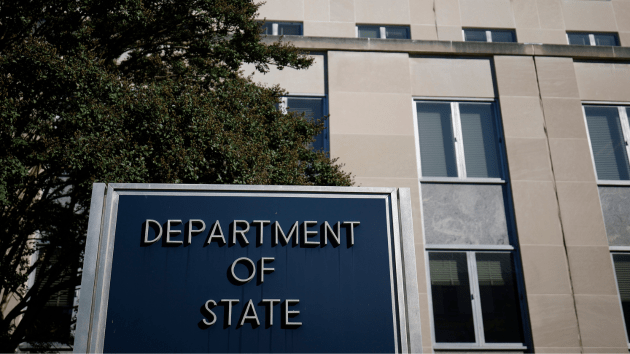
The Harry S. Truman Federal Building, headquarters of the U.S. Department of State, is pictured on October 08, 2024 in Washington, DC.
(WASHINGTON) — A federal judge on Friday struck down the Trump administration’s policy suspending immigrant visa issuance for nationals of 75 countries, setting aside refusals based solely on the policy and requiring those cases to be reconsidered by consular officers under the normal immigration laws.
U.S. District Judge Jeannette A. Vargas said the policy, announced by the State Department in January, “is contrary to law and was issued in excess of Secretary Rubio’s statutory authority.”
The directive instructed U.S. embassies and consulates to suspend immigrant visa adjudications while the State Department reassessed its vetting procedures under existing immigration law.
The State Department said in January the pause was intended to “prevent the entry of foreign nationals who would take welfare and public benefits.”
Vargas said Friday the policy conflicts with federal immigration law, which gives consular officers “exclusive authority and discretion” to determine whether an immigrant is eligible for a visa.
“The Policy, which categorically prohibits the issuance of immigrant visas based upon the nationality of the applicant, represents a direct abrogation of this statutory scheme,” Vargas wrote.
The judge’s order also vacates visa denials that were based solely on the policy.
“The suspension of lawful visa processing across 75 countries separated spouses, parents, and children who were simply following the legal immigration process,” said Anna Gallagher, executive director of the Catholic Legal Immigration Network Inc., the group that filed the lawsuit challenging the policy.
“Catholic social teaching calls us to uphold the dignity of every person and recognize the family as the foundation of society,” Gallagher added. “Today’s decision affirms both those values and the rule of law, allowing families to once again move forward toward reunification.”
The State Department did not immediately respond to ABC News’ request for comment, nor has it indicated it is going to appeal the decision.
“The Trump administration is bringing an end to the abuse of America’s immigration system by those who would extract wealth from the American people,” a State Department spokesman said in a statement when the policy was announced. “The State Department will use its long-standing authority to deem ineligible potential immigrants who would become a public charge on the United States and exploit the generosity of the American people.”
Marine One (L) carrying U.S. President Donald Trump lifts off from The Ellipse near the White House en route to Joint Base Andrews on Aug. 27, 2026, in Washington, D.C. (Andrew Harnik/Getty Images)
(WASHINGTON) — Presidential helicopter Marine One lost communication with air traffic controllers at Reagan National Airport for the second time this month, according to audio reviewed by ABC News.
The incident occurred on Thursday, just one hour after federal officials released a report saying the problem was fixed.
President Donald Trump was about to take off from the White House Ellipse when Marine One pilots gave a three-minute warning to controllers, but in air traffic control audio another helicopter can be heard relaying the information to the tower after controllers failed to respond.
Moments later, a controller can be heard saying she did not hear anything from Marine One.
“Marine One is trying to reach you. Three minutes to lift,” a nearby helicopter pilot said to the tower.
“Oh I couldn’t hear any of that. Thank you,” a controller responded.
A few minutes later, Marine One tried to contact the tower two more times, but the controller didn’t hear the transmission and asked another chopper in the air if they can hear Marine One.
“Hey Nighthawk 8, do me a favor, I can’t hear Marine One,” the controller said. If you hear Marine One can you let me know?”
Once Marine One lifted off from the Ellipse, it regained communication ability with the tower and proceeded to take Trump to Joint Base Andrews, where he boarded Air Force One.
A similar incident happened on Aug. 4, when Marine One took off at the same time an American Airlines regional jet was lifting off from nearby Ronald Reagan Washington National Airport (DCA).
The two aircraft came within .82 miles and 700 feet vertically, but were not on a collision course. Normally all air traffic is held until the president’s helicopter is out of the area.
FAA rules require that commercial aircraft maintain a minimum of 1.5 miles horizontal separation and 500 feet vertical separation from any helicopter passing near DCA.
The National Transportation Safety Board (NTSB) and the Federal Aviation Administration launched an investigation. FAA engineers determined that a radio transmitter did not allow line of sight to Marine One’s temporary landing area on the White House Ellipse. The temporary landing zone is being used while White House construction takes place on the South Lawn.
The FAA moved the transmitter to the top of the control tower at Reagan National Airport from a local residential area. Tests conducted following the move showed Marine One had no further communication issues, according to the NTSB report released Thursday.
The FAA released a statement to ABC News, but did not explain how this happened again.
“The FAA took immediate action following the Aug. 4 incident involving Marine One, including relocating an antenna to improve communications between DCA air traffic controllers and Marine One pilots and reviewing the procedures involved,” the agency said. “The three-minute notification was communicated by alternate means, acknowledged by a controller and positive contact was established with Marine One before takeoff.”
Video tripods sit empty on the White House grounds on Sept. 21, 2026, in Washington, D.C. Reporters from MS NOW, CNN, and Politico have been blocked from accessing the White House since September 19th after President Trump said he was banning the three outlets from the property. Those news organizations are now suing President Trump, alleging that it violates the First Amendment. (Finn Gomez/Getty Images)
(WASHINGTON) — The three news outlets banned from the White House by President Donald Trump on Monday filed a First Amendment lawsuit to restore their access.
CNN, MS NOW and Politico are seeking a temporary restraining order demanding the White House restore their reporters’ credentials after Trump announced the ban on Friday.
In a joint statement on Monday, the three news outlets said the lawsuit aims to “protect our First Amendment rights and defend the principle that the government does not decide what the press reports or publishes.”
“Without notice or process, the White House revoked our journalists’ credentials because it objected to our reporting. Left unchallenged, this threatens press freedom and the public’s right to independent journalism free from government interference,” the statement said.
Trump said in a social media post following the news on Monday that the barring of journalists was not “an assault on the Free Press” but instead “an assault on the FAKE NEWS,” which he claimed was a national security “threat.”
Trump said in a post to social media on Friday, “Media Outlets shouldn’t be able to constantly write or report FICTION and LIES when they’re covering the President of the United States, the Trump Administration, or the United States of America.”
At an event in the Oval Office shortly after he posted his message, the president suggested there may be more restrictions on other outlets. Trump told reporters he supports a free press, but that “you need a fair and honest press.”
“It’s sick. I mean, there’s something wrong with a country that can allow people to write purposely negative stuff. Now, if they want to write them, that’s fine. But I don’t have to let them into my, into the people’s house,” Trump said.
Journalists from the three outlets were turned away from the White House over the weekend. A reporter from CNN said on air that she was told by a Secret Service agent that her badge had been deactivated.
The three outlets are challenging the legality of the president’s ban on multiple fronts, according to the lawsuit.
The lawsuit argues the ban violates the outlets’ reporters’ due process rights, that it unlawfully retaliates against their protected speech and that it violates the First Amendment by barring them from a nonpublic forum for unlawful reasons.
“This ban could not be a more direct assault on the First Amendment nor a more blatant violation of our most fundamental constitutional principles,” the news outlets wrote.
The lawsuit warns of a cascading effect for other news organizations should Trump seek to expand the scope of the ban, as he said he may do in his Friday remarks in the Oval Office.
“The ban is already severely impeding the ability of CNN, MS NOW, and POLITICO to cover the President and his administration,” according to the lawsuit. “Every day, critically important news is breaking at the White House and in the press pool: President Trump is the commander in chief of a country at war; he is traveling to New York today to address the United Nations General Assembly tomorrow; he is meeting with China’s President Xi Jinping at the White House on Thursday; and he is steering national policy on the ever-advancing technology of artificial intelligence. And the ban inflicts an injury on all news media organizations—who now risk a similar fate if they engage in reporting the President deems insufficiently favorable.”
The five members of the White House TV pool — ABC News, NBC News, CBS News, Fox News Media and CNN — issued a statement on the matter on Monday, saying, “The public has a vital interest in receiving accurate, independent information about its government. No administration should restrict a news organization because it objects to its reporting.”
Vice President JD Vance on Monday pushed back on the notion that Trump’s actions constituted a ban, saying that the White House would not provide “special access” to outlets it deems are spreading “propaganda” against the president and his agenda.
“He’s not banning media outlets. What he’s doing is saying we’re not going to give you special access to the White House if you engage in what is effectively propaganda,” Vance said.
Trump’s initial social media post said he was “banning” the news outlets.
Vance was pressed by pool reporters traveling to with him on how this is not an attack on the First Amendment. Vance said the outlets are still able to report on the White House — it’s just that they won’t be able to maintain what he called “special access” to the building.
“Well, they can still report on the Trump White House. They can still get the public reports. They can still, of course, talk to people in the administration and outside the administration. What the president has said is, ‘we’re not going to give you special access inside the White House,'” Vance said.
The civil case has been assigned to D.C. District judge Timothy Kelly, who in 2018 oversaw former CNN correspondent Jim Acosta’s lawsuit that similarly sought to restore his press pass.
At the time, Judge Kelly, a Trump appointee, ruled in Acosta’s favor after finding that the Trump White House did not afford him proper due process in revoking his credentials.
The full D.C. Circuit and the Supreme Court have yet to establish settled precedent in the wake of Trump’s earlier attempted ban on The Associated Press from being part of the press pool and attending certain White House events last year.
While a D.C. District court judge backed the AP, a three-judge panel with the D.C. Circuit put the ruling on hold and later wrote that “restricted presidential spaces are not First Amendment fora opened for private speech and discussion.”
Monday’s lawsuit is expected to cite a 1977 ruling in which the full D.C. Circuit found that the White House cannot arbitrarily deny a journalist a press pass without due process.
“As the D.C. Circuit has long held, the interest that members of the press have in their White House hard passes is ‘protected by the first amendment’ and ‘undoubtedly qualifies as liberty which may not be denied without due process of law under the fifth amendment,'” the attorneys wrote, according to the court papers shared by Politico.
ABC News’ Fritz Farrow and Hannah Demissie contributed to this report.
U.S. President Donald Trump speaks after signing an executive order during an event in the Oval Office of the White House on Aug. 27, 2026, in Washington, D.C. (Andrew Harnik/Getty Images)
(WASHINGTON) — For a second time, a federal judge on Friday rejected President Trump’s attempt to move his criminal hush money case to federal court, where his conviction could be vacated.
“The grounds for a second removal cited by Defendant, Donald J. Trump, are neither new nor legally sufficient. He has failed to show good cause and diligence,” Judge Alvin Hellerstein decided.
Trump was convicted of 34 felony counts of falsifying business records related to a $130,000 hush payment to adult film actress Stormy Daniels, whose legal name is Stephanie Clifford. He is appealing his conviction.
A federal appeals court ordered Hellerstein to take a second look at Trump’s attempt to move the case from state to federal court after the U.S. Supreme Court’s landmark immunity opinion.
“I reaffirm my former decision. The president’s motion is denied,” Hellerstein said.
Trump has argued the Supreme Court’s controversial 2024 presidential immunity decision, which established sweeping protection from prosecution for “official acts,” made some of the evidence and testimony from the prosecution’s case off-limits.