Judge denies request for stay of Kennedy Center renaming order
Construction workers build scaffolding near the sign for the Donald J. Trump and John F. Kennedy Memorial Center for the Performing Arts on June 12, 2026 in Washington, DC. (Anna Moneymaker/Getty Images)
(WASHINGTON) — A federal judge on Friday denied the Department of Justice’s request to lift an order requiring the removal of President Donald Trump’s name from the Kennedy Center.
The Trump administration still faces a deadline of Friday to remove Trump’s name from the building.
This is a developing story. Please check back for updates.
U.S. President Donald Trump speaks during a proclamation signing ceremony in the Oval Office of the White House on June 11, 2026 in Washington, DC.. (Photo by Alex Wong/Getty Images)
(WASHINGTON) — Immediately after celebrating his 80th birthday with Sunday’s UFC fight on the White House South Lawn, President Donald Trump is expected to head to France to meet with top global superpowers at the annual G7 summit.
Held in Évian-les-Bains, France from June 15 to 17, this will be the president’s fifth time attending the conference in person and comes amid heightened global turmoil, with the conflicts in Iran and Ukraine expected to loom large over the summit’s economic and geopolitical agenda.
This is the first time the G7 leaders are meeting in-person since the start of the U.S.-Iran war, which has now reached its 15th week and continues to impact the global economy, with increases in fossil fuel and oil and gas prices. The war had caught U.S. allies off guard and some were unwilling to heed the president’s requests for help, which has created tensions between Trump and some G7 leaders.
There is expected to be a focus on the Middle East, with Trump scheduled to participate in bilateral meetings with Egypt, Qatar and the United Arab Emirates, according to a senior administration official.
While the past week saw significant military escalation between the U.S. and Iran, Trump said Sunday that the two countries had reached an agreement that would open the Strait of Hormuz, through which about 20% of the global oil supply passes through.
During the G7 summit last year, Trump left one day early because of the growing conflict between Israel and Iran, and that weekend launched Operation Midnight Hammer against Iran’s nuclear facilities.
Like last year, leaders are also looking to secure lasting peace in Ukraine. It has been 4 1/2 years since Russia invaded Ukraine, but the war is escalating, especially with Ukraine’s expansion of long-range drone attacks against Russia. Trump repeatedly promised that he personally could end the Russia-Ukraine war on the first day of his presidency and Ukrainian leader Volodymyr Zelenskyy continues to seek more assistance from allies.
Zelenskyy will meet with G7 leaders on Tuesday, according to a senior administration official, but there is no one-on-one meeting currently scheduled with Trump. Ukraine was also not listed as one of the U.S. goals for the summit, though the administration emphasizes that resolving the conflict remains one of the president’s “top priorities.”
The other six countries that comprise the G7 coalition include France, Canada, Germany, Italy, Japan, and the United Kingdom, but leaders of other countries are often also invited to the annual conference, with Zelenskyy reportedly expected to be in attendance.
During a background call previewing the trip, a senior White House administration official said Trump’s goals include addressing “economic growth and development, supply chain resilience, illegal immigration and artificial intelligence,” in addition to boosting investment partnerships.
Upon assuming his second term, Trump has strained his relationship with the other G7 leaders. In addition to prompting other countries to question his actions in Iran, the president has distanced the U.S. from top allies over his rhetoric towards NATO, his tariffs and his ambitions in acquiring Greenland, to name a few issues.
The conference was originally scheduled to begin on Sunday. Officials did not comment on whether the president’s birthday plans for that day played a role in shifting the G7 schedule forward.
On the final day of the summit on Wednesday, Trump is expected to travel to Paris to have dinner with French President Emmanuel Macron at the Palace of Versailles before heading back to Washington.
U.S. President Donald Trump speaks to members of the press for the first time aboard the new Air Force One while in flight from RAF Mildenhall AFB to Joint Base Andrews July 8, 2026 after leaving the United Kingdom. (Photo by Win McNamee/Getty Images)
(NEW YORK) — The Secret Service urged President Donald Trump to fly out of Turkey on the old Air Force One instead of the newly retrofitted Qatari-gifted plane out of an abundance of caution amid the escalation with Iran, multiple sources familiar with the plans told ABC News.
The Qatari-gifted plane left the NATO summit in Turkey earlier in the day for Mildenhall Air Force Base in England, a move Trump claimed Wednesday morning was for members of the military to tour the aircraft.
While Trump has said the change in plane had nothing to do with security concerns, he also reiterated, when asked by reporters if security concerns caused the change in flight plans, that he’s “No. 1 on the kill list for Iran.”
The change in plans was not prompted by a specific threat, but influenced in part by differences in the plane security capabilities, two U.S. officials told ABC News.
Mike Centrella, the Secret Service’s former head of field operations, said the law enforcement agency “simply doesn’t take chances when it comes to the president’s safety, whether at home or abroad.”
“Presidential travel is incredibly complex, and every movement and potential risk is carefully considered,” Centrella told ABC News. “The mindset is always the same: plan for what you know, prepare for what you don’t and make sure you’re ready for the unexpected.”
Steven Cheung, the White House communications director, told ABC News on Thursday that “the new Air Force One is a state-of-the-art aircraft that has been fitted with high-level security protocols that ensure the safety of the president and his staff. As the president has said recently, there are many enemies of America who have their sights on him, and we use every tool at our disposal — including distraction and misdirection — to address those threats.”
The New York Times first reported on the Secret Service recommendation.
When the president ultimately left Turkey in the old Air Force One to link up with the new plane in England, passengers on the aircraft were instructed to keep their windows down during the flight. According to flight data, the plane carrying the president did not turn on its tracker until it was over the Black Sea near Istanbul.
Despite continuing to insist there was no security issue that prompted him to change planes for his Turkey departure, Trump suggested that the passengers may have been asked to keep their window shades down because they were “probably on a dangerous flight.”
“Well, yeah, because you’re, you know, probably on a dangerous flight, because of the sleaze bags that we have to deal with,” Trump said, referring to Iran.
While the administration insists that the newly acquired plane meets the safety and security requirements necessary to fly the president, the speed of the retrofitting, which took about one year, has raised questions about whether the Qatari-gifted plane boasts the same defensive security measures as the old plane.
Many of the details of the retrofitting on the new plane are considered classified. The Air Force has said the new plane is “safe, secure and equipped with the most advanced technologies necessary to meet the requirements of the presidential mission. Those requirements were carefully crafted to prioritize mission over aesthetics, leaving much of the previous head of state interior layout minimally changed.”
On Tuesday, a group of Senate Democrats sent a letter to Air Force Secretary Troy Meink demanding transparency into the project from the Air Force and L3Harris, claiming the administration is ignoring national security concerns so in service of delivering Trump a “fancy plane for his personal enjoyment.”
Trump took his first trip in the newly retrofitted plane last week on a trip to North Dakota.
Before the first trip, the U.S. Air Force had been modifying the jet in Texas since September to meet the security, communications and other needs to transport the president. The Air Force had estimated it would cost less than $400 million to retrofit the gift.
The plane is to be used as the new Air Force One until shortly before Trump leaves office, at which time ownership of the plane will be transferred to the Donald J. Trump Presidential Library Foundation, sources familiar with the proposed arrangement have told ABC News.
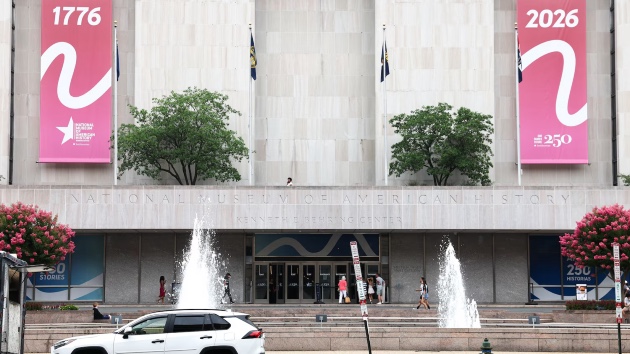
The Smithsonian American History Museum on July 07, 2026 in Washington, DC. (Finn Gomez/Getty Images)
(WASHINGTON) — The director of the Smithsonian’s National Museum of American History (MNAH) is scheduled to testify before two congressional House committees this week amid sharp criticism from the White House over the contents of the Washington, D.C. museum.
Anthea Hartig is set to face grilling by lawmakers on Tuesday morning in a House Subcommittee on Delivering Government Efficiency hearing titled “Rewriting American History: Examining the Smithsonian’s Efforts to Reshape the Past,” according to a committee press release.
She is also expected to testify in a related hearing on Wednesday before the Committee on House Administration, a committee spokesperson confirmed to ABC News. ABC News has reached out to the Smithsonian for confirmation.
Hartig was named in a scathing White House Domestic Policy Council report released on July 4, accusing the MNAH and its leadership of engaging in “extreme political activism” and presenting “a radical view of American history.”
Asked about the report, a spokesperson for the Smithsonian told ABC News on July 5 that the institution remains committed to impartial learning.
“For more than 180 years, the Smithsonian has served the American public with nonpartisan and independent scholarship, and we remain committed to doing so,” the spokesperson said.
Hartig’s testimony this week would mark the first time that a top leader at the Smithsonian gets grilled publicly by Congress after President Donald Trump targeted the institution in his March 27, 2025 executive order, “Restoring Truth and Sanity to American History.”
The executive order directed Vice President J.D. Vance, in consultation with the president’s advisers on domestic policy, “to remove improper ideology” from Smithsonian institutions, arguing that materials that cast America in a “negative light” have no place in federal cultural institutions.
The White House last year launched an investigation into the Smithsonian, which oversees 21 museums, galleries and the national zoo, and released the July 4 report targeting the American history museum as part of this probe.
The report accuses the museum of “anti-White activism,” “illegal alien activism,” and “transgender activism.” It also includes many photos of materials the White House has identified as problematic.
Smithsonian Secretary Lonnie Bunch, who has not addressed the report publicly, disputed its findings in an internal letter to staff that was obtained by ABC News.
Bunch wrote that Smithsonian leadership is “carefully” reviewing the report’s findings, but said that the report’s assessment is “not a fair characterization.
“While there will always be room for improvement, this report is not a fair characterization of the work and totality of the National Museum of American History,” Bunch said in the letter. “At the Smithsonian, our work is driven by scholarship, accuracy, and an uncompromising commitment to tell the fullness of America’s story.”
“As public servants and the keepers of this institution, we are charged with helping a nation find understanding, hope, and clarity and as part of that duty, we are dedicated to excellence, reflection, and growth,” Bunch added.
The report was published by the White House Domestic Policy Council. Vince Haley, the group’s director, said in a statement to ABC News that “No American wants the Smithsonian’s National Museum of American History to be a system of ideological activism.”
“Unfortunately, the report demonstrates that is exactly what the Smithsonian’s flagship museum has become,” he said. “It is our hope and expectation that the Smithsonian will eventually rise once again to that noble obligation — to tell America’s story for our children, the world, and future generations of Americans,” he added.